AFRINIC IPv4 Transfers in 2026: What Works, What Is Stuck
Short answer (checked 2026-11-27): IPv4 registered with AFRINIC can change hands inside the AFRINIC region under section 5.7 of its policy manual, and between two existing AFRINIC members the registry charges no transfer fee. It still cannot move to or from the RIPE NCC, ARIN, APNIC or LACNIC. AFRINIC ratified a Number Resources Transfer Policy on 04.02.2026 that allows inter-RIR transfers with reciprocal registries, but it keeps AFRINIC-issued IPv4 in the region, AFRINIC has published no start date, and both the RIPE NCC and ARIN still list AFRINIC as closed. AFRINIC itself still has free IPv4: 565,248 addresses were marked available in its delegation file today.
Checked on 2026-11-27. AFRINIC: resource transfers (intra-region rules, section 5.7), ratified policies (AFPUB-2020-GEN-006-DRAFT03, "Ratified - 04.02.2026"), fee schedule, news and communiques (CEO designate 2026-08-24, election results 2026-07-03), the policy list post of the Policy Liaison Team of 2026-06-01 (reciprocity re-verified in April 2026). RIPE NCC inter-RIR transfers and ARIN transfers pages. Data: AFRINIC
transfers_latest.jsonanddelegated-afrinic-extended-latest(both produced 2026-11-27), ARINtransfers_latest.json(newest entry 2026-11-25).
What works: transfers inside the AFRINIC region
AFRINIC's transfer page points to one rule set, the intra-RIR IPv4 transfer policy in section 5.7 of the Consolidated Policy Manual, plus separate guidelines for mergers and acquisitions. In short:
- Both sides are in the region. The recipient must be an AFRINIC member (or become one) and sign the Registration Service Agreement.
- The recipient justifies need. AFRINIC evaluates the recipient's need for the space, as ARIN and LACNIC do and as the RIPE NCC does not inside its own region.
- The seller waits 12 months. After an approved transfer the source cannot receive new IPv4 allocations or assignments from AFRINIC for 12 months.
- No quick flips. The source must not have received a transfer, allocation or assignment in the 12 months before the approval.
- Paperwork. Both parties sign the transfer application form.
Fees are low by registry standards. AFRINIC's fee schedule says it does not charge "at the moment" for transfers between two existing resource members; a recipient that is new to AFRINIC pays the allocation fee for the size it receives plus the membership fee of its category. For the smallest LIR category (Extra Small, /22 up to a /20) that is US$ 1,750 once and US$ 1,400 a year. The same schedule excludes resources issued for critical infrastructure from transfers, and it still describes itself as "the fee schedule as of 2008 unless otherwise amended", so confirm the amounts with AFRINIC before you budget. AFRINIC publishes no processing time.
What is stuck: transfers to and from other registries
AFRINIC's community worked on inter-RIR transfers for years; the version that went through is AFPUB-2020-GEN-006-DRAFT03, "Number Resources Transfer Policy", listed on AFRINIC's ratified-policies page as "Ratified - 04.02.2026". According to AFRINIC's own summary, inter-RIR transfers are "formally allowed, under specific conditions and where reciprocal arrangements exist", and "AFRINIC-issued IPv4 cannot be transferred out of the region"; categories such as legacy resources and space that came in from another region "may be eligible" for an outbound transfer.
That is one-sided by design. A buyer in Europe could, once the policy is live, bring IPv4 into AFRINIC, and a holder of legacy or imported space could send it out; a holder of ordinary AFRINIC allocations could not sell to a buyer in another region. On the AFRINIC policy list, AFRINIC's Policy Liaison Team wrote on 2026-06-01 that reciprocity with the other RIRs was re-verified in April 2026; a participant replied the next day that the policy is not fully reciprocal for exactly this reason.
What counts for a deal today is what the other side does. On 2026-11-27 the RIPE NCC's inter-RIR page still says "AFRINIC does not currently have an inter-RIR policy. This means that no resources of any kind can be transferred to/from this region", and ARIN's transfer page lists AFRINIC as "Not Approved for Transfers". AFRINIC has published no date when its systems will process an inter-RIR request. How moves between the other four registries work is in our inter-RIR transfer guide.
Governance in 2026: why timing is uncertain
AFRINIC has spent the last years under court supervision in Mauritius. Its own news page shows the arc: a notice of appointment of the Receiver on 2025-02-17; the 2025 board election, annulled by the Receiver on 2025-06-26 after a dispute over proxy votes (as reported by BTW Media); a notice on the termination of the receivership on 2025-11-05; a court update on 2026-05-15; election results announced on 2026-07-03 from the AFRINIC-37 meeting in Nairobi; and on 2026-08-24 the Board, "with the consent of the Receiver", named Mike Silber CEO designate from 2027-01-01. On 2026-10-31 AFRINIC issued a statement on Cloud Innovation's entry on its register of members, a sign the long dispute with that member is not over.
For a transfer this means two things. AFRINIC is processing intra-region transfers (its log has entries in 2026), but no one can promise a timeline, and an inter-RIR start date depends on a registry whose leadership changes hands on 1 January 2027. We confirm the registry's current situation before committing either side of a deal; the region's notes are on /ipv4/afrinic.
What AFRINIC's own transfer log shows
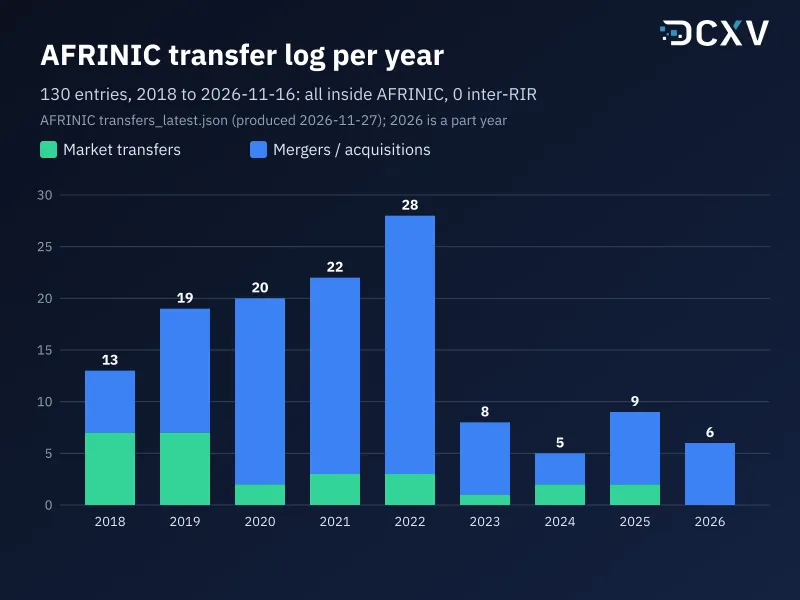
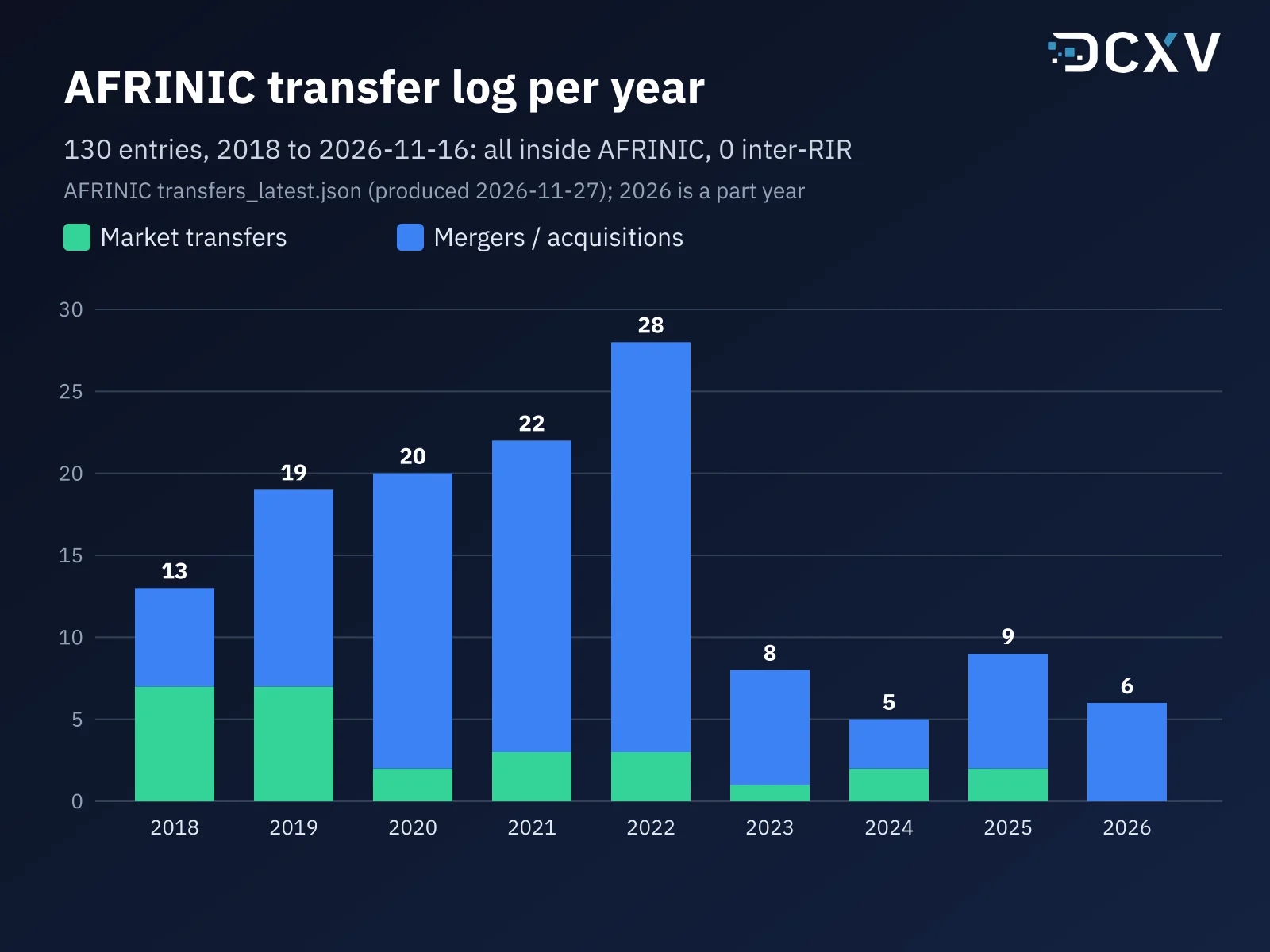
AFRINIC publishes its transfer log and its delegation file in the same JSON and text formats as the other registries. We ran our own script over both, and over ARIN's log for any trace of AFRINIC: entries per year split into mergers and acquisitions and market transfers, block sizes and country pairs of the market transfers, the delegated space by country, and the size of what AFRINIC itself handed out in the last 12 months.
Output, run on a DCXV Cloud server with Bun 1.4.4 on 2026-11-27:
AFRINIC transfer log: 130 entries, 2018-02-12 to 2026-11-16 (produced 2026-11-27)
Registry pairs: AFRINIC->AFRINIC 130

Year  M&A  (IPv4 addr)   market  (IPv4 addr)
2018    6      160,000        7       14,336
2019   12      393,984        7       64,000
2020   18    1,203,968        2       10,240
2021   19    3,421,952        3       25,600
2022   25      515,328        3        6,144
2023    7      115,456        1        2,048
2024    3       33,792        2       73,728
2025    7      386,560        2       18,432
2026    6       56,832        0            0
All   103    6,287,872       27      214,528

Market transfers: 29 IPv4 ranges; sizes /20 8, /22 7, /21 5, /18 3, /19 2, /24 2, /17 1, /16 1
Country pairs: ZA->ZA 16, GH->ZA 3, KE->UG 1, TZ->TZ 1, MU->MU 1; cross-border 8 of 27
Largest market transfers:
     65,536  2024-06-28  ZA -> ZA
     32,768  2019-02-04  ZA -> ZA
     20,480  2021-07-08  BJ -> CI

Delegated file header: 2|afrinic|20261127|20015|00000000|20261127|00000
IPv4 by status: allocated 110,327,808, assigned 5,822,208, reserved 4,535,040, available 565,248
Delegated IPv4: 116,150,016; ZA 23.4%, EG 20.8%, MA 10.6%, SC 6.9%, TN 6.8%
Delegated since 20251127: 305 records, 231,680 addresses
Sizes delegated since 20251127: /22 189, /24 83, /23 33

ARIN transfer log (newest 2026-11-25): 46291 entries, 0 with AFRINIC as source or recipient
ARIN inter-RIR entries by partner: RIPE NCC 3162, APNIC 1432, LACNIC 526
How to read it:
- The market is tiny. In almost nine years AFRINIC logged 27 market transfers moving 214,528 addresses, none in 2026 so far. For scale, the RIPE NCC logged 253 market transfers in October 2026 alone (October 2026 IPv4 market report). Most AFRINIC log entries (103 of 130, 6,287,872 addresses) are mergers and acquisitions, which move space with a company, not between a buyer and a seller.
- It is South African. 16 of the 27 market transfers were between two South African organisations, and 3 more went from Ghana to South Africa; only 8 crossed a border.
- Nothing crosses a registry boundary. All 130 entries are AFRINIC to AFRINIC, and ARIN's log of 46,291 transfers, 5,120 of them inter-RIR, has none with AFRINIC on either side.
- AFRINIC still hands out addresses. 305 delegations in the last 12 months, 189 of them /22s and none larger, and 565,248 addresses marked available. At last year's pace that is about 2.4 years of supply (our arithmetic; the 4,535,040 reserved addresses are not counted). An eligible new member in Africa may get a /22 from AFRINIC instead of buying one.
AFRINIC vs RIPE NCC vs ARIN
| AFRINIC | RIPE NCC | ARIN | |
|---|---|---|---|
| Inter-RIR transfers | Policy ratified 04.02.2026, not live; AFRINIC-issued IPv4 may not leave | With ARIN, APNIC, LACNIC; AFRINIC listed as closed | With APNIC, LACNIC, RIPE NCC; AFRINIC "Not Approved" |
| Recipient justifies need | Yes, to AFRINIC | Inter-RIR only | Yes, under NRPM 8.3 / 8.4 |
| Seller limits | No new AFRINIC IPv4 for 12 months; nothing received in the 12 months before | 24-month hold on received space (RIPE-807) | No ARIN IPv4 received in the past 12 months |
| Registry transfer fee | None between existing members; new recipient pays allocation + membership fees | None; LIR fee applies | 2027: $187.50 recipient fee for a /24, $500 source fee |
| Free pool | 565,248 available, up to /22 (2026-11-27) | Waiting list, one /24 per new LIR | Waiting list |
RIPE NCC and ARIN rows are from our checks of 2026-10-29 to 2026-11-24 (RIPE-807, ARIN NRPM 8.4 and the ARIN 2027 fee schedule).
What this means if you buy or hold AFRINIC space
- You need addresses for a network in Africa. Ask AFRINIC first: a new member can still receive a /22 from the free pool, and the registry fees are far below what 1,024 addresses cost on the market (a /22 sold for a 90-day median of $19.00 per address on ip4.market to 2026-11-22, about $19,500 for the block; dated figures on /ipv4/pricing). If you need more or faster, buy inside the region under section 5.7 and check the block's history first.
- You need addresses for a network in Europe or the Americas. Do not plan on AFRINIC space. Buy in the registry where you will use it; if you only need addresses for a while, a lease is the other route. You can buy IPv4 addresses through our desk in the RIPE, ARIN, APNIC and LACNIC regions.
- You hold ordinary AFRINIC allocations and want to sell abroad. You cannot today, and the ratified policy keeps AFRINIC-issued IPv4 in the region even after it goes live. Your buyers are AFRINIC members; you can still sell IPv4 addresses to one of them through a broker.
- You hold legacy or imported space registered with AFRINIC. You are in the category the new policy may let out. Wait for AFRINIC to publish an implementation date and for the RIPE NCC and ARIN pages to change, and do not sign a deal that assumes an inter-RIR move before then.
- Paying. Use escrow that releases on the registry change; see IPv4 escrow payment milestones.
DCXV brokers IPv4 transfers inside the regions and between them and is a RIPE NCC member (AS204057). Holding or looking for AFRINIC space? Talk to the IPv4 desk or email ipv4@dcxv.com.