JPNIC IPv4 Transfers in 2026: Rules, Fees, 778 Cases
Short answer (checked 2026-11-22): JPNIC, Japan's national registry under APNIC, has run IPv4 transfers since August 2011 and lists 778 of them on its own transfer history page (as of 2026-11-19). The recipient needs a contract with JPNIC (or with the receiving registry), both sides sign a JPNIC application, and each signature comes with a registered company seal certificate. JPNIC puts the shortest case at about two weeks. A block brought in from APNIC, ARIN or the RIPE NCC costs a JPY 88,000 transfer fee, and holding the space costs an annual fee from JPY 61,710 for a /24 in FY2027. Most Japanese space changes hands inside Japan: 589 of the 757 cases between different organisations stayed inside JPNIC, and only 11 ever went to the RIPE NCC. For a price on a specific block, see /ipv4/pricing.
Checked on 2026-11-22. Rules: JPNIC's IPv4 and AS number transfer page (dated 2022-08-22). History: JPNIC's IPv4 transfer history (as of 2026-11-19). Fees: JPNIC's fee page and maintenance fee table (FY2026 and later amounts valid from 2026-03-31). Registry log: APNIC's
transfer-apnic-latest(newest entry 2026-11-20). APNIC's 103/8 rule: APNIC's transfer conditions. Yen at the ECB reference rates of 2026-11-20 (USD 1 = JPY 158.64). The wider NIR picture is in our APNIC NIR transfer guide.
What JPNIC allows
JPNIC's transfer page sets out a short list of conditions:
- What can move. IPv4 that JPNIC manages and IPv4 managed by APNIC, ARIN or the RIPE NCC. The page words it as blocks "larger than /24"; its own history lists /24 cases, so read it as /24 and up and confirm a specific block with JPNIC. IPv6 cannot be transferred under the current policy.
- Who can send. The organisation registered as the holder in the registry's database.
- Who can receive. An organisation that holds, or will sign, a contract to manage the space, usually JPNIC's IP address management designated member contract. For a block leaving Japan, the recipient deals with its own registry instead.
- One exception. IPv4 on JPNIC's list of blocks whose reverse DNS JPNIC itself runs cannot be moved to another registry.
- No matchmaking. JPNIC does not introduce buyers and sellers. It publishes a list of organisations that want to receive IPv4, and anyone can ask to be put in touch through it.
- Mergers are different. A merger or a business transfer follows a separate JPNIC procedure, not the transfer application.
JPNIC's page names no holding period for space that arrived by transfer. APNIC does have one rule to check: addresses from its 103/8 final pool cannot be transferred for five years after the original delegation.
How a JPNIC transfer runs
- Agree terms. Both organisations must agree to the change of holder before anything is filed.
- File the application. One IPv4 transfer application form (Japanese). Where a company seal is used, the seal registration certificate goes with it: from the seller for a transfer inside JPNIC or out of it, and from the buyer for a transfer inside JPNIC or into it.
- Size check and fee. A block coming into JPNIC from another registry needs JPNIC's notice of the transferable size and the JPY 88,000 fee; inside JPNIC this applies only to some transfers.
- Contracts. Depending on each side's current contract, JPNIC may ask for a new contract or a termination. A new designated member contract costs JPY 275,000 once.
- Completion. JPNIC says about two weeks from filing in the shortest case, not counting questions or contract steps. A transfer to another registry also needs that registry's own process: for the RIPE NCC side, see our inter-RIR transfer page.
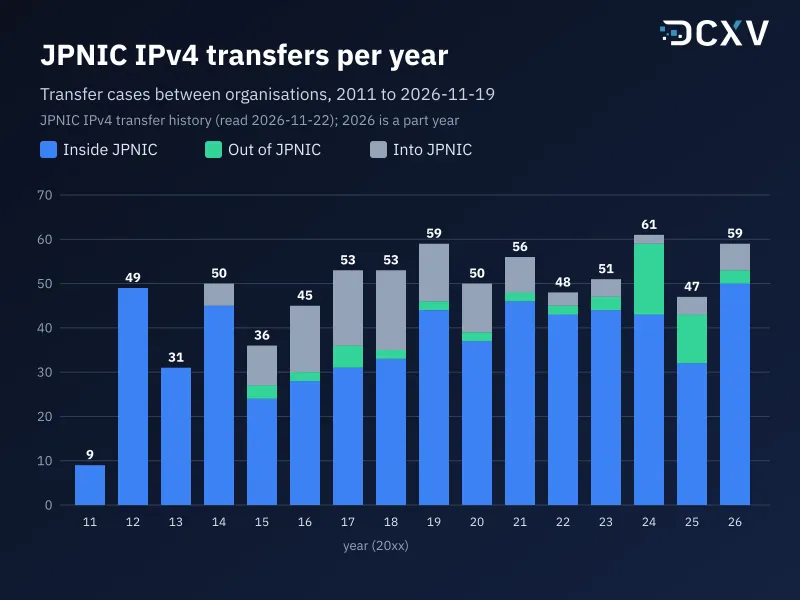
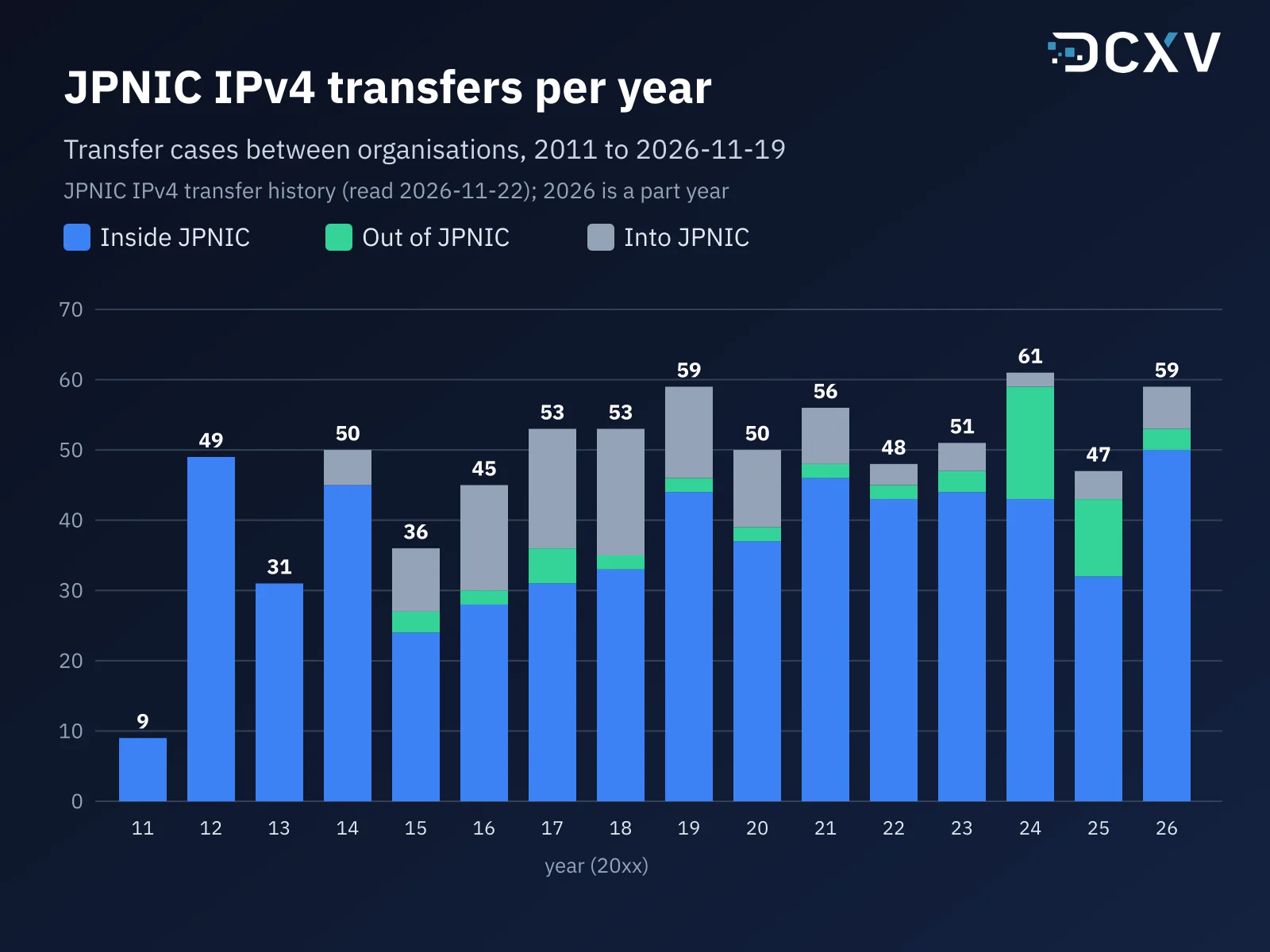
778 JPNIC transfers since 2011
We ran our own script over JPNIC's transfer history page and over APNIC's transfer log, which records every IPv4 prefix with a JPNIC member on either side. Output, run on a DCXV Cloud server with Bun 1.4.4 on 2026-11-22:
JPNIC IPv4 transfer history (2026-11-19): page total 778 cases, parsed 778, 1838 prefixes
Year  cases  same-org (note 1)  between orgs  prefixes between orgs
2011      9                  0             9                     32
2012     53                  4            49                    210
2016     45                  0            45                    175
2020     50                  0            50                     99
2023     51                  0            51                    117
2024     62                  1            61                    197
2025     47                  0            47                     76
2026     60                  1            59                    117
Between different organisations, all years: 757 cases
  JPNIC -> JPNIC      589 cases; 2024 43, 2025 32, 2026 50
  ARIN -> JPNIC        49 cases; 2024 1, 2025 0, 2026 2
  APNIC -> JPNIC       47 cases; 2024 1, 2025 3, 2026 4
  JPNIC -> APNIC       34 cases; 2024 10, 2025 5, 2026 1
  RIPE NCC -> JPNIC    19 cases; 2024 0, 2025 1, 2026 0
  JPNIC -> RIPE NCC    11 cases; 2024 3, 2025 3, 2026 2
  JPNIC -> ARIN         8 cases; 2024 3, 2025 3, 2026 0

APNIC transfer log: 11,169 IPv4 records, newest 20261120
Involving a JPNIC member: 1,298 records, 20120314 to 20261106
2024 prefixes out of JPNIC, top recipients: ORACLE-4 (ARIN) 20, Amazon.com, Inc. (APNIC-direct) 7, Infinivan Inc. (APNIC-direct) 3

Last 12 months (20251122 to 20261106): 67 records, 1,788,672 addresses as logged
  distinct prefixes: 57, 1,223,424 addresses (a prefix that moved twice counted once)
  JPNIC->JPNIC                52 records   1,468,928 addresses
  JPNIC->RIPE                  6 records     147,456 addresses
  APNIC-direct->JPNIC          4 records      20,736 addresses
  ARIN->JPNIC                  3 records      77,824 addresses
  RIPE->JPNIC                  1 records      65,536 addresses
  JPNIC->APNIC-direct          1 records       8,192 addresses
  Block sizes: /20 20, /19 14, /21 13, /22 8, /16 3, /18 3, /13 2, /15 2, /24 1, /23 1
  Median age of the block's previous delegation at transfer: 24.2 years (67 records)

Same prefix logged again within 365 days of its previous transfer: 119 records (11 in the last 12 months)
  Most frequent holder in between: GMO-BRS 46, sakura 28, BBIXINTLNET 11, vectant 6

delegated-apnic-extended: 889,094,336 IPv4 delegated in the APNIC region; JP 188,593,920 (21.2%)
  Largest economies: CN 38.6%, JP 21.2%, KR 12.7%, AU 5.2%
Years 2013-2015, 2017-2019, 2021 and 2022 are cut from the first table here; the chart at the top shows every year. How to read it:
- A steady, domestic market. Between 31 and 61 cases a year since 2012, and 59 so far in 2026. 589 of the 757 cases between organisations stayed inside JPNIC. Note 1 cases (21 in total) are one company moving space between its own contracts, not sales.
- Japan buys about as much as it sells abroad. Over all years 115 cases came into JPNIC from ARIN, APNIC accounts and the RIPE NCC; 53 went out. The outflow peaked in 2024 (16 cases), when APNIC's log shows 20 prefixes going to Oracle at ARIN and 7 to Amazon's APNIC account.
- Few small blocks. In the last 12 months the APNIC log holds one /24 and one /23 with a JPNIC member involved; /21 to /19 is the normal size. A buyer who wants a single /24 of Japanese space has little to choose from.
- Old space. The median logged delegation date is 24.2 years before the transfer: most of these blocks were handed out in the early 2000s or earlier.
- Intermediaries hold space briefly. 119 records show the same prefix moving again within a year, most often after a stop with one holder (GMO-BRS in 46 cases). JPNIC does not block quick resale.
- The two sources count differently. JPNIC lists cases (one case can hold many prefixes); APNIC logs prefixes, and the same prefix can appear twice. The raw total of 1,788,672 addresses in the last 12 months counts repeated prefixes twice, among them 219.8.0.0/13; counting each prefix once gives 1,223,424.
What JPNIC IPv4 costs to hold
JPNIC bills a yearly maintenance fee on a member's total IPv4, on a log scale: twice the space costs much less than twice the fee. The FY2026 rates rose from the FY2025 table and step up again in FY2027 and FY2028. Selected amounts from JPNIC's table, tax included, if this is the member's whole JPNIC IPv4 holding:
| Total IPv4 held | FY2026 | FY2027 | FY2027 in USD | Per address a year (FY2027) |
|---|---|---|---|---|
| /24 (256) | JPY 60,500 | JPY 61,710 | $388.98 | $1.52 |
| /22 (1,024) | JPY 105,415 | JPY 108,340 | $682.91 | $0.67 |
| /20 (4,096) | JPY 183,675 | JPY 190,204 | $1,198.93 | $0.29 |
| /16 (65,536) | JPY 557,631 | JPY 586,250 | $3,695.38 | $0.06 |
Our arithmetic at USD 1 = JPY 158.64. One-off costs on top: the JPY 88,000 transfer fee ($554.70, about $2.17 per address on a /24) where it applies, and JPY 275,000 ($1,733.44) for a new designated member contract. JPNIC full members get a reduced maintenance fee. For comparison, a RIPE NCC LIR pays a flat EUR 1,894 in 2027 whatever it holds, and ARIN's 3X-Small tier is $288.75 a year from 2027-01-01. On a single /24 the JPNIC fee is moderate; for a large holder it is cheap per address.
Prices are a separate matter. IPv4.Global's disclosed APNIC-region sales in the 12 months to 2026-11-20 had medians of $23.50 per address for a /24 (18 sales) and $25 for /23-/22 (16), in our count of 2026-11-21. Japanese blocks are not shown separately in that list; see the APNIC price guide for the region.
What this means for buyers and sellers
- Buying for a network in Japan. You need a JPNIC contract first; budget the JPY 275,000 contract fee if you are new, the transfer fee if the block comes from another registry, and the yearly fee. Expect /21 to /19 blocks rather than /24s.
- Buying for a network in Europe. A JPNIC block reaches a RIPE LIR as an inter-RIR transfer through APNIC: JPNIC releases it, the RIPE NCC records it, and RIPE rules apply from then on, including the 24-month hold. It happened 11 times in 15 years, so allow for a seller who has never done it. Registry notes are on /ipv4/apnic.
- Selling JPNIC space. Check that the block is not on JPNIC's reverse-DNS list if the buyer is abroad, have the seal certificate ready, and remember that the buyer pool is mostly domestic: 589 of 757 cases.
DCXV brokers IPv4 transfers between the regions and is a RIPE NCC member (AS204057). Buying or selling Japanese space? Talk to the IPv4 desk or email ipv4@dcxv.com.