APNIC to RIPE IPv4 Transfers in 2026: Rules, Fees, Flows
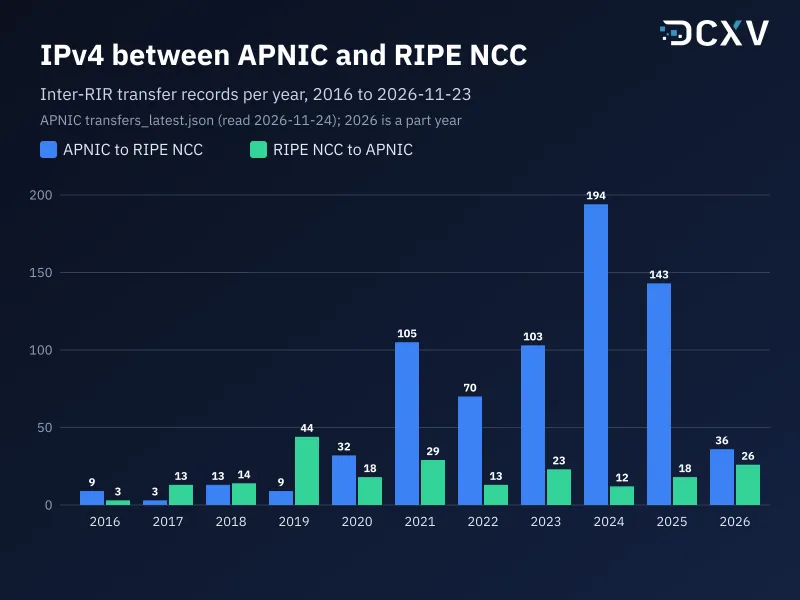
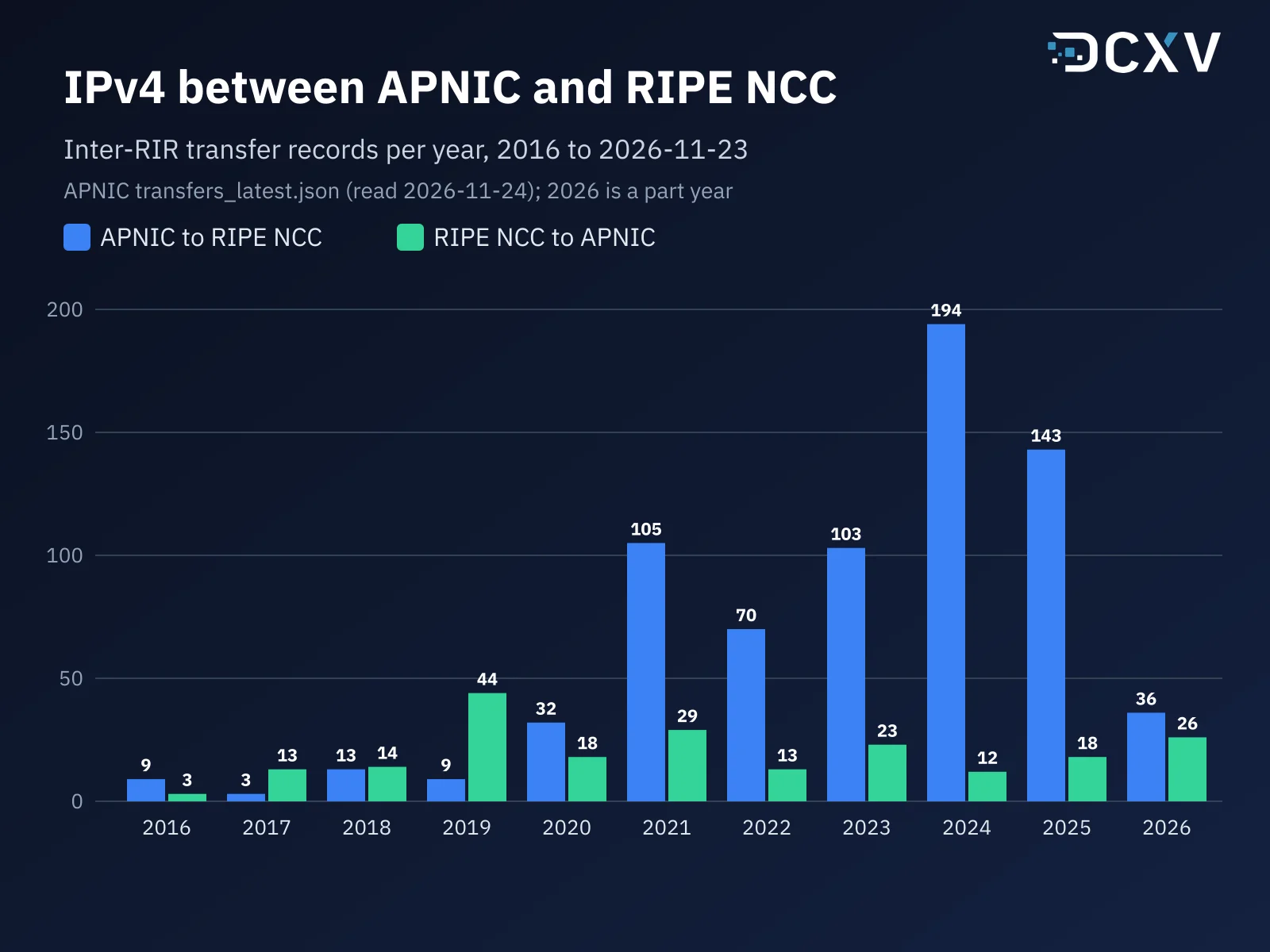
Short answer (checked 2026-11-24): IPv4 can move between APNIC and the RIPE NCC in both directions, in blocks of /24 or larger. The transfer starts in the region the space leaves, and both registries must approve it. An APNIC seller pays APNIC a transfer fee of 20% of the annual fee for the block being moved: AUD 259 for a /24 in 2026, AUD 271.20 in 2027. The RIPE NCC charges no transfer fee, but the buyer must be a RIPE NCC member and cannot pass the space on for 24 months. In the other direction, an APNIC buyer must show a plan to use the space within 24 months. APNIC's own log holds 717 IPv4 transfers from APNIC to the RIPE NCC and 213 back since 2016, and the APNIC-to-RIPE flow fell from 194 in 2024 to 36 so far in 2026. For a price on a specific block, see /ipv4/pricing.
Checked on 2026-11-24. APNIC side: APNIC-127 Internet Number Resource Policies v015 (20 February 2025), sections 11.1-11.2; APNIC transfer conditions; APNIC-120 Member Fee Schedule v011 (6 March 2026). RIPE side: RIPE-807 transfer policies, RIPE-769 inter-RIR procedure and the RIPE NCC inter-RIR transfers page. Data: APNIC
transfers_latest.json(produced 2026-11-23) and the RIPE NCC transfer table (newest entry 2026-11-23). Currency at the ECB reference rates of 2026-11-23. The ARIN route is in our ARIN to RIPE guide.
The rules on each side
APNIC processes an inter-RIR transfer only when the other registry has a policy that allows transfers with the APNIC region; the RIPE NCC has one. APNIC-127 section 11.2 then splits the conditions by side: the source follows the rules of the registry where it holds its account, and so does the recipient.
| Rule | APNIC to RIPE NCC | RIPE NCC to APNIC |
|---|---|---|
| Minimum size | /24 (APNIC-127 11.2.1) | /24 (APNIC-127 11.2.1) |
| Who starts | APNIC seller, at APNIC | RIPE seller, at the RIPE NCC |
| Buyer's conditions | RIPE NCC member; 24-month hold on the space (RIPE-807 2.2.1, 3.1) | APNIC account; plan for use within 24 months (APNIC-127 11.1.3) |
| Seller's conditions | Registered holder, no dispute; 103/8 space locked 5 years | Space not received in the last 24 months (RIPE-807 2.2.1) |
| Registry fee | Seller pays APNIC 20% of the block's annual fee | APNIC buyer pays the 20% fee, with exceptions (below) |
Two details matter in practice. First, RIPE-807 section 3.2 asks a RIPE buyer for a plan to use 50% of the space within five years only when the source region requires the receiving region to have needs-based policies. APNIC leaves the buyer's conditions to the receiving registry (section 11.2.3), so on our reading that clause is not triggered for space from APNIC; confirm it with the RIPE NCC for your case. Second, APNIC asks every APNIC recipient for a detailed plan for the use of the space within 24 months, and a recipient that already holds IPv4 must also show its past usage rate and compliance with APNIC policy. That is a real document, not a formality, and it is the step that slows RIPE-to-APNIC deals.
What APNIC charges for a transfer
APNIC-120 sets the transfer fee at 20% of the annual fee that applies to the resources being transferred, per transaction. For a move to another registry, the source APNIC member pays. The annual fee is AUD 1,295 x 1.32^(log2(addresses) - 8) in 2026 and AUD 1,356 x 1.325^(...) in 2027. Applied to a single block (our arithmetic, at EUR 1 = USD 1.0939 = AUD 1.6532):
| Block | Transfer fee 2026 | Transfer fee 2027 | 2027 in USD | USD per address |
|---|---|---|---|---|
| /24 (256) | AUD 259.00 | AUD 271.20 | $179.45 | $0.70 |
| /23 (512) | AUD 341.88 | AUD 359.34 | $237.77 | $0.46 |
| /22 (1,024) | AUD 451.28 | AUD 476.13 | $315.05 | $0.31 |
| /20 (4,096) | AUD 786.31 | AUD 835.90 | $553.10 | $0.14 |
The fee does not apply to the first IPv4 transfer into an account that holds no addresses (that account pays the full annual fee instead), to IPv4 transfers to NIR members, or to a membership change to or from an NIR. Account holders in Least Developed Countries get 50% off. An NIR such as JPNIC or IRINN may charge its own fee on top; see our APNIC NIR guide.
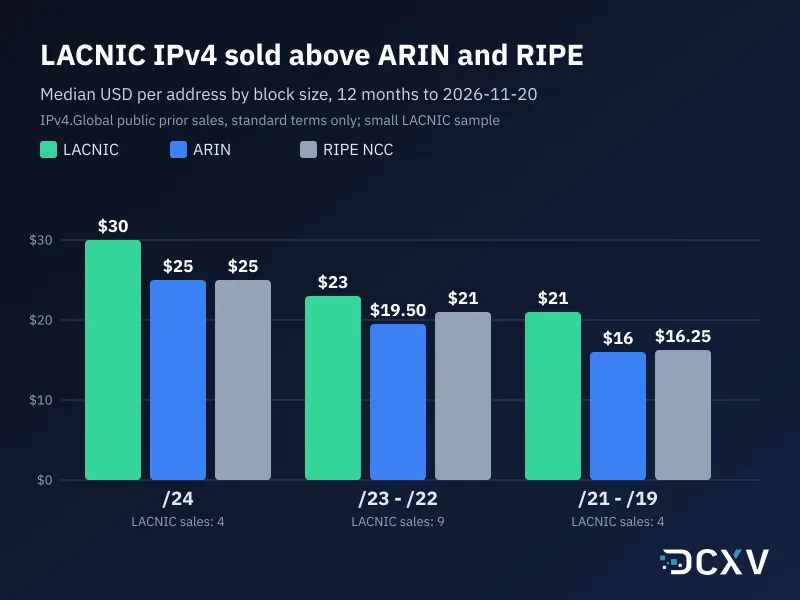
On the RIPE side there is no transfer fee. The buyer pays membership: EUR 1,000 sign-up for a new LIR and a flat EUR 1,894 a year from 2027. Next to a /24 price of around $25 per address (our count of IPv4.Global's disclosed RIPE-region sales in the 12 months to 2026-11-20; APNIC-region /24 median $23.50 on 18 sales), the APNIC fee adds about 3% to the deal.
930 transfers in APNIC's log since 2016
We ran our own script over APNIC's transfer log and the RIPE NCC transfer table. Output, run on a DCXV Cloud server with Bun 1.4.4 on 2026-11-24:
APNIC transfer log: 7,091 IPv4 records, production 2026-11-23

All years, inter-RIR records involving APNIC
  APNIC->RIPE NCC    717 records   4,192,768 addresses, first 2016-02-08
  RIPE NCC->APNIC    213 records   3,779,072 addresses, first 2016-09-28
  APNIC->ARIN        264 records   2,516,480 addresses, first 2015-08-05
  ARIN->APNIC        550 records  23,555,840 addresses, first 2012-10-08

Per year      APNIC->RIPE           RIPE->APNIC
  2021   105    248,064         29    230,656
  2022    70    210,944         13    194,048
  2023   103    678,912         23    288,256
  2024   194  1,331,712         12     70,144
  2025   143    301,056         18    316,160
  2026    36    179,968         26    614,912

Last 12 months (2025-11-23 to 2026-11-23) APNIC->RIPE NCC: 39 records, 183,040 addresses, median /23
  sizes: /24 15, /22 10, /23 10, /19 1, /15 1, /20 1, /18 1
  APNIC-side economy: PK 13, JP 5, ZZ 5, AU 5, SG 3, NZ 2
  APNIC-side org, top: WORLDCALL TELECOM LIMITED 12

Last 12 months (2025-11-23 to 2026-11-23) RIPE NCC->APNIC: 31 records, 717,312 addresses, median /21
  sizes: /22 7, /23 6, /21 5, /17 3, /24 2, /20 2, /19 2, /16 1, /14 1, /15 1, /18 1
  APNIC-side economy: HK 10, SG 4, ZZ 4, ID 3, JP 2, VN 2

APNIC->RIPE all years by source economy: IN 230, AU 111, BD 81, ZZ 65, JP 47, HK 44
APNIC->RIPE from India (IN) by year: 2020 12, 2021 31, 2022 35, 2023 30, 2024 72, 2025 45, 2026 1
APNIC->RIPE all years by source account: APNIC-direct 498, IRINN 205, JPNIC 12, IDNIC 1, TWNIC 1

RIPE transfer table: 44,058 entries, newest 2026-11-23 (inter-RIR arrivals are not listed in it)
  APNIC->RIPE blocks later transferred again inside RIPE (POLICY, all or part): 51 of 717
  median 30.7 months after arrival; under 24 months: 0
  RIPE->APNIC blocks with an earlier RIPE POLICY transfer: 22 of 213; median 44.3 months between; under 24: 0
Years 2016-2020 and the smaller lines are cut here; the chart at the top shows every year. How to read it:
- More deals go from APNIC to Europe, but not more addresses. 717 records went from APNIC to the RIPE NCC against 213 back, but the addresses are close: 4.19 million against 3.78 million. APNIC-to-RIPE deals are small (median /23 in the last 12 months, 15 single /24s); RIPE-to-APNIC deals are larger (median /21, including a /14 and a /15).
- India drove the APNIC-to-RIPE flow, then stopped. 230 of 717 records came from Indian holders, 205 of them through IRINN, India's NIR. Indian sources sent 72 blocks in 2024 and 45 in 2025, but only one in 2026, on 2026-05-21. We found no published rule change that explains it; we only see it in the log.
- 2026 is a quiet year for APNIC-to-RIPE moves. 36 records to 2026-11-23, against 143 in 2025 and 194 in 2024. One Pakistani seller, Worldcall Telecom, accounts for 12 of the 39 in the last 12 months.
- Hong Kong and Singapore buy from Europe. Of 31 RIPE-to-APNIC records in the last 12 months, 10 went to Hong Kong and 4 to Singapore holders.
- The 24-month hold is respected. 51 of the 717 blocks that arrived from APNIC were later sold again inside the RIPE region, none within 24 months (median 30.7 months). Of the 213 blocks that left for APNIC, 22 had an earlier RIPE market transfer, also none within 24 months.
- ZZ in the log means no country is given for the holder.
Step by step: APNIC seller, RIPE buyer
- Price and terms. Agree the block, the price and who pays the APNIC fee (the seller is billed; the contract can move the cost). Check that the block is not 103/8 space delegated less than five years ago, and check its reputation on blocklists.
- Buyer ready at RIPE. The buyer must be a RIPE NCC member with no unpaid invoices (RIPE-769 3.3). Opening a new LIR takes its own time, so start it before the seller files.
- Seller files at APNIC. The request starts in the region the space leaves. APNIC checks the holder, the size and the fee; if the seller is an NIR member, the request goes through the NIR first.
- RIPE NCC review. The RIPE NCC checks the buyer's side and both registries approve. Neither publishes a target time; the RIPE NCC says only that inter-RIR transfers take longer than transfers inside its region.
- Registration. The block appears in the RIPE Database under the buyer, and the 24-month hold starts. Create the route object and the ROA for your ASN, and set up reverse DNS.
The reverse direction is the same in mirror image, with one more task for the APNIC buyer: write the 24-month usage plan before the RIPE seller files. Our inter-RIR transfer page and the APNIC registry notes cover the paperwork.
Where APNIC to RIPE deals stall
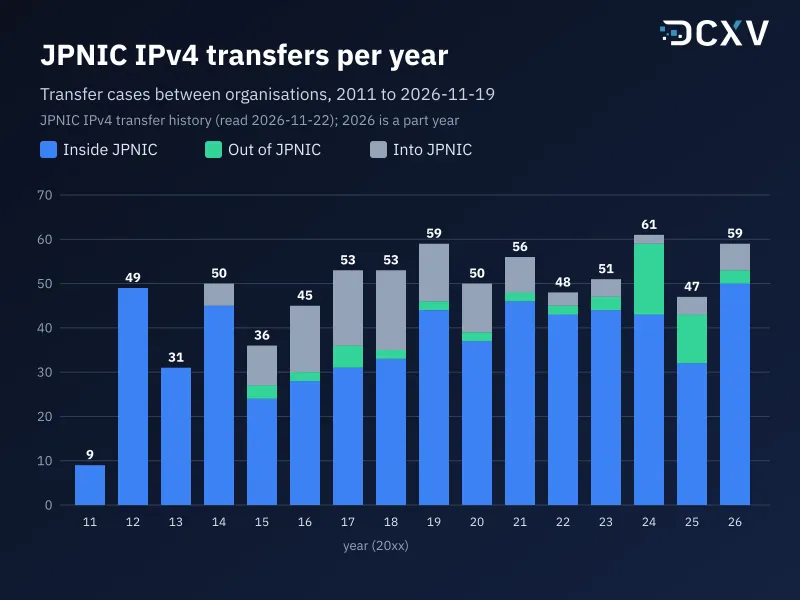
- NIR blocks. Space under JPNIC, CNNIC, KRNIC, TWNIC or IRINN goes through the NIR, which has its own rules and fees. Of 717 APNIC-to-RIPE records only 14 came from NIR accounts other than IRINN; Japanese space leaves rarely.
- The APNIC usage plan. For RIPE-to-APNIC moves, a buyer with no clear 24-month plan waits or is refused.
- Unpaid invoices and disputes. RIPE-769 requires both parties to have cleared their obligations; APNIC requires an undisputed holder.
- Geolocation. After the move, GeoIP databases may keep placing the block in Asia until they refresh; plan a geolocation fix.
What this means for buyers and sellers
- Buying for a European network. APNIC space is a real option: in the last 12 months most APNIC-to-RIPE deals were /24 to /22, the APNIC fee is a few hundred AUD, and the price level is close to RIPE's. Budget the 24-month hold before you can resell.
- Selling APNIC space to Europe. You pay the APNIC fee and start the request; have the block's history clean and, if you are an NIR member, talk to your NIR first.
- Buying for Asia from Europe. Prepare the APNIC usage plan early. Larger blocks move this way, so an Asian buyer looking for a /21 or more may find it in the RIPE region.
DCXV brokers IPv4 transfers between the regions and is a RIPE NCC member (AS204057). Buying or selling across APNIC and RIPE? Talk to the IPv4 desk or email ipv4@dcxv.com.