
IPv4 Escrow Payment Timeline: Buyer and Seller Checklist
An IPv4 escrow is a private arrangement that holds the buyer's money until written conditions are met. It does not replace the registry: the RIR still decides the transfer under its own policy. This post covers only payment checkpoints, mutual confirmations and fund-release conditions. For the registry procedure itself, read the RIPE NCC transfer guide. Price context is on /ipv4/pricing.
Checked on 2026-10-14. RIPE NCC: the offering LIR (or the sponsoring LIR of the offering End User) files the request, both parties supply registration or identity documents and sign a transfer agreement (not needed between LIRs of the same member), and the page describes no payment or escrow step and states that transfers are free of charge. ARIN (NRPM 8.3): source and recipient each file a request and ARIN invoices its own fees. APNIC: the recipient must demonstrate need. None of these pages describes a payment arrangement between the parties. Policies change, so re-check before you sign.
Roles: who confirms what
| Role | Confirms | Does not do |
|---|---|---|
| Seller | Holder status, authority to sign, no third-party claims | Ask for release before the registry record changes |
| Buyer | Eligibility as recipient, source of funds, the deposit | Pay outside the agreed route |
| Brokers (if any) | Process, paperwork, fee terms | Approve the transfer |
| Escrow provider | Funds received, release or return per written conditions | Judge registry policy |
| RIR | Evaluates the request under its own policy | Run payments or escrow, guarantee your deal's date |
The payment checkpoints
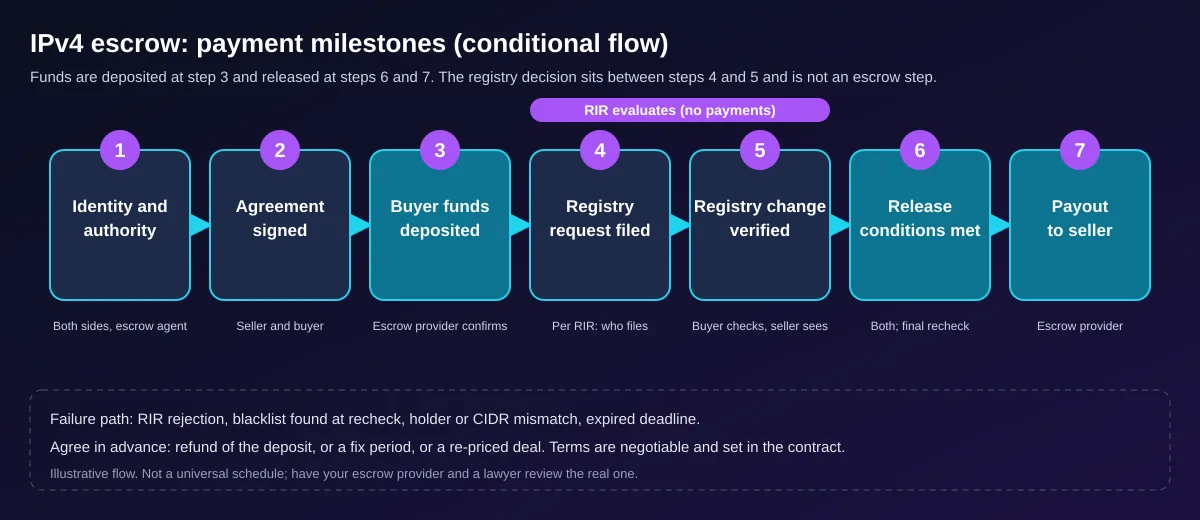
| # | Checkpoint | Confirmed by | Evidence |
|---|---|---|---|
| 1 | Identity and authority | Both sides, escrow provider | Company register extract, proof of signatory authority, the provider's own checks |
| 2 | Agreement signed | Seller and buyer | Signed sale contract with exact CIDR, RIR, price, deadlines; the RIR's transfer agreement is separate |
| 3 | Buyer deposit | Escrow provider | Written confirmation of the full amount to both sides |
| 4 | Registry request | Offering party (RIPE); source and recipient each (ARIN 8.3); other RIRs per their own procedure | Request reference(s) and a list of submitted documents |
| 5 | Registry change verified | Buyer checks, seller sees | Dated registry record showing the buyer as holder of the exact CIDR |
| 6 | Release conditions met | Both sides in writing | Signed release instruction, dated recheck report at closing |
| 7 | Payout | Escrow provider | Payout notice to the seller, statement of fees |
Fix these terms before money moves
- Exact resource - every CIDR, the RIR, the status (PA, PI or legacy) and third-party rights such as a lease, a ROA or a sponsoring LIR.
- State at closing - which blacklist, routing and abuse results are acceptable, and when they are rechecked (due diligence checklist).
- Deadlines - who must act by when, and what a missed date does.
- Refunds and disputes - when the deposit returns, who decides, which court or arbitration applies.
- Fees - who pays escrow and brokerage fees. These are negotiable terms: ask each provider in writing.
- Price basis - dated observations only; see IPv4 pricing and the pricing guide.
Evidence without oversharing
- Share registry extracts, company documents, proof of signatory authority and dated report PDFs.
- Never share portal passwords, API tokens, 2FA codes or maintainer credentials. The party that holds the account performs the action.
- Minimise personal data - give the escrow provider and the broker only what their own checks need, and redact the rest.
Failure cases and what to agree in advance
| Case | Agree in advance |
|---|---|
| The RIR rejects the request | Is the deposit returned in full, who bears escrow fees, how long may documents be fixed |
| A blacklist or abuse listing appears between signing and closing | Price adjustment, remediation period or right to withdraw; which lists and severity count |
| Wrong holder or name mismatch | Who corrects the record; funds stay locked until it matches the contract |
| Contract and registry disagree (CIDR, RIR, status) | Which document prevails; amend before any release |
| Verification is slow | Longest wait before either side may exit; no automatic release on silence |
Example milestone schedule (conditional)
Illustrative only. This is not a universal schedule and not a term of DCXV or of any escrow provider. The actual escrow provider and a lawyer must review the real one. It states no durations.
| Stage | Condition to move on | Money |
|---|---|---|
| A. Agreement | Both signed, exact CIDR listed | None |
| B. Deposit | Escrow confirms the full amount | Held |
| C. Registry request | Filed and accepted for evaluation within deadline 1 | Held |
| D. Registry change | Record shows the buyer as holder | Held |
| E. Closing recheck | Reputation meets the agreed threshold | Held |
| F. Release | Both confirm in writing, or the contract's stated trigger | Paid to seller minus agreed fees |
Discuss a Secure IPv4 Transfer - DCXV is a broker that can discuss a secure transfer with you. Choose your side: I am buying | I am selling
Next step
Start with the checkpoint table, then write the terms into the contract. Questions about a transfer: ipv4@dcxv.com. Related: how to sell an IPv4 block, broker vs marketplace vs direct sale.