How Much Is a /24, /22, /20 or /16 IPv4 Block Worth in 2026?
There is no single IPv4 price. A /24, a /22, a /20 and a /16 sell at different per-IP levels, and the same block can move by a wide margin depending on its registry, status and history. All figures below are dated observations, not quotes, and the live view is on IPv4 pricing.
Why there is no single IPv4 price
IPv4 is traded one block at a time, privately, and no public exchange prints a closing price. Every number you see is an observation: a seller's ask, a broker's deal flow or a survey. Each has a date, a registry, a block size and a source, and each stops being true as the market moves. For the longer view of how the market got here, read the price history 2020-2026.
Price per IP versus total block value
Brokers and buyers quote a price per IP because it lets you compare blocks of different sizes.
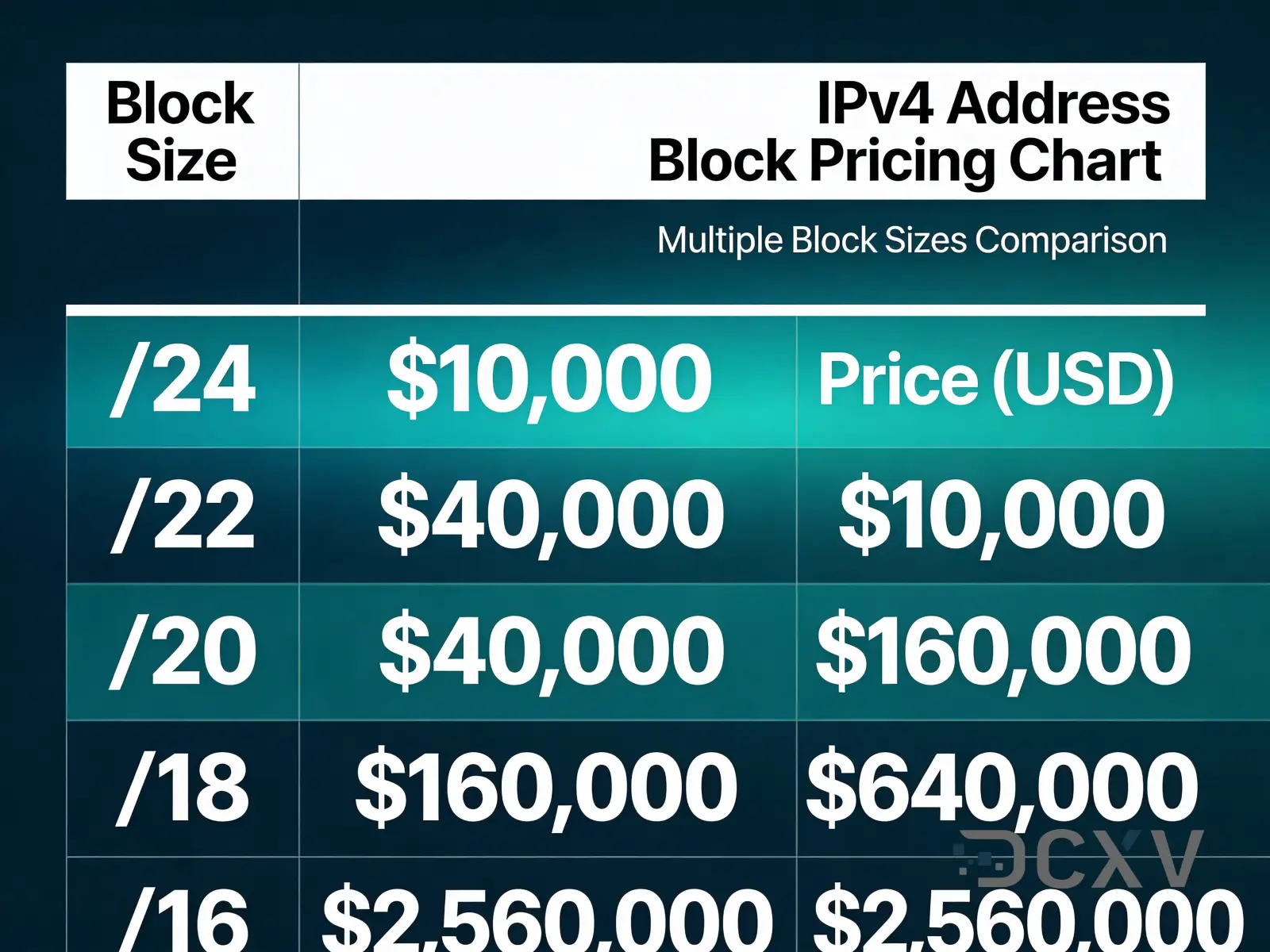
| Block | IPs | Total at the RIPE per-IP range |
|---|---|---|
| /24 | 256 | $10,240-$13,824 |
| /22 | 1,024 | $38,912-$53,248 |
| /20 | 4,096 | $147,456-$204,800 |
| /16 | 65,536 | $2,228,224-$3,145,728 |
The totals above are plain arithmetic on the RIPE per-IP range from the observation table below (DCXV brokerage flow, April 2026, USD).
Comparing /24, /22, /20 and /16 blocks
| Block | IPs | RIPE per IP | ARIN per IP | APNIC per IP |
|---|---|---|---|---|
| /24 | 256 | $40-$54 | $42-$58 | $35-$50 |
| /22 | 1,024 | $38-$52 | $40-$55 | $33-$47 |
| /20 | 4,096 | $36-$50 | $38-$52 | $31-$45 |
| /16 | 65,536 | $34-$48 | $36-$50 | $29-$43 |
Observation: DCXV brokerage flow, April 2026, USD per IP, RIPE NCC, ARIN and APNIC regions, blocks /24 to /16. The data does not split asking prices from executed ones, so treat it as a range of the market's reach, not a transaction record.
What moves the price
- RIR - RIPE NCC, ARIN and APNIC have different rules, demand and buyer pools, so never carry one registry's range over to another.
- Block size - bigger blocks usually show a lower per-IP figure but a longer sales cycle.
- PA, PI or legacy status - the status shapes which transfers are possible and which buyers can take the block.
- Transfer eligibility - a block that cannot clear the registry's transfer rules has little value, whatever the ask.
- Blacklist and abuse history - listed ranges cost money to clean; see how to check a block before buying.
- Geolocation history - a block that geolocates to the wrong country is hard to use for a regional service.
- Routing history - a clean, long-visible announcement history is worth more than a block that was never routed.
- Fragmentation and documentation - one contiguous block with clear papers sells faster than scattered pieces.
- Timing and payment terms - fast cash, escrow or staged payment each carry a different price.
Asking price versus executable price
An asking price is what a seller hopes to get. An executed price is what a buyer actually paid and closed. When you read any range, check which of the two it is. If the source does not say, assume it is asking. A broker's estimate is also not a guaranteed sale price: it is an informed range under stated assumptions, and the final figure depends on the buyer, the block and the timing. For the sell-side process see how to sell an IPv4 block, and for the channel choice see broker vs marketplace vs direct sale.
Costs outside the headline price
- Broker fee - DCXV publishes its fee bands on IPv4 pricing.
- Escrow - a third party may hold funds until the transfer completes.
- Registry fees - each RIR has its own charging scheme; read it on the official site.
- Legal and documentation - contracts, authority checks and translations take time and sometimes outside help.
- Clean-up and setup - delisting, route objects and RPKI records can be needed before the block is usable.
How DCXV evaluates a block
We start with the registry, block size and status, then the transfer path and the paperwork. Next we check blacklists, geolocation and routing history, and compare the block with what we see in our own brokerage flow. The result is a range with its assumptions written down, never a promise. The process for the transfer itself is in the RIPE NCC transfer guide, and the wider buy and sell picture is in the IPv4 buy and sell guide.
Next step
Selling? Get a valuation for your IPv4 block: send the registry, prefix size, status and any history notes to ipv4@dcxv.com or use IPv4 sell. Buying? Request available IPv4 blocks through IPv4 buy. The live ranges and fee bands are on IPv4 pricing. You can also start at https://dcxv.com/ipv4.