SpaceX Gets 1 Million Orbital Data Centers: A Reality Check
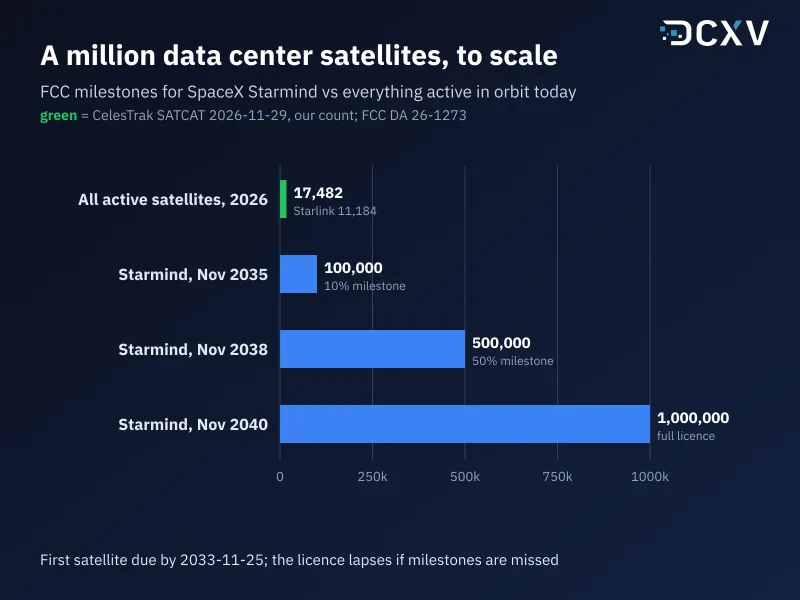
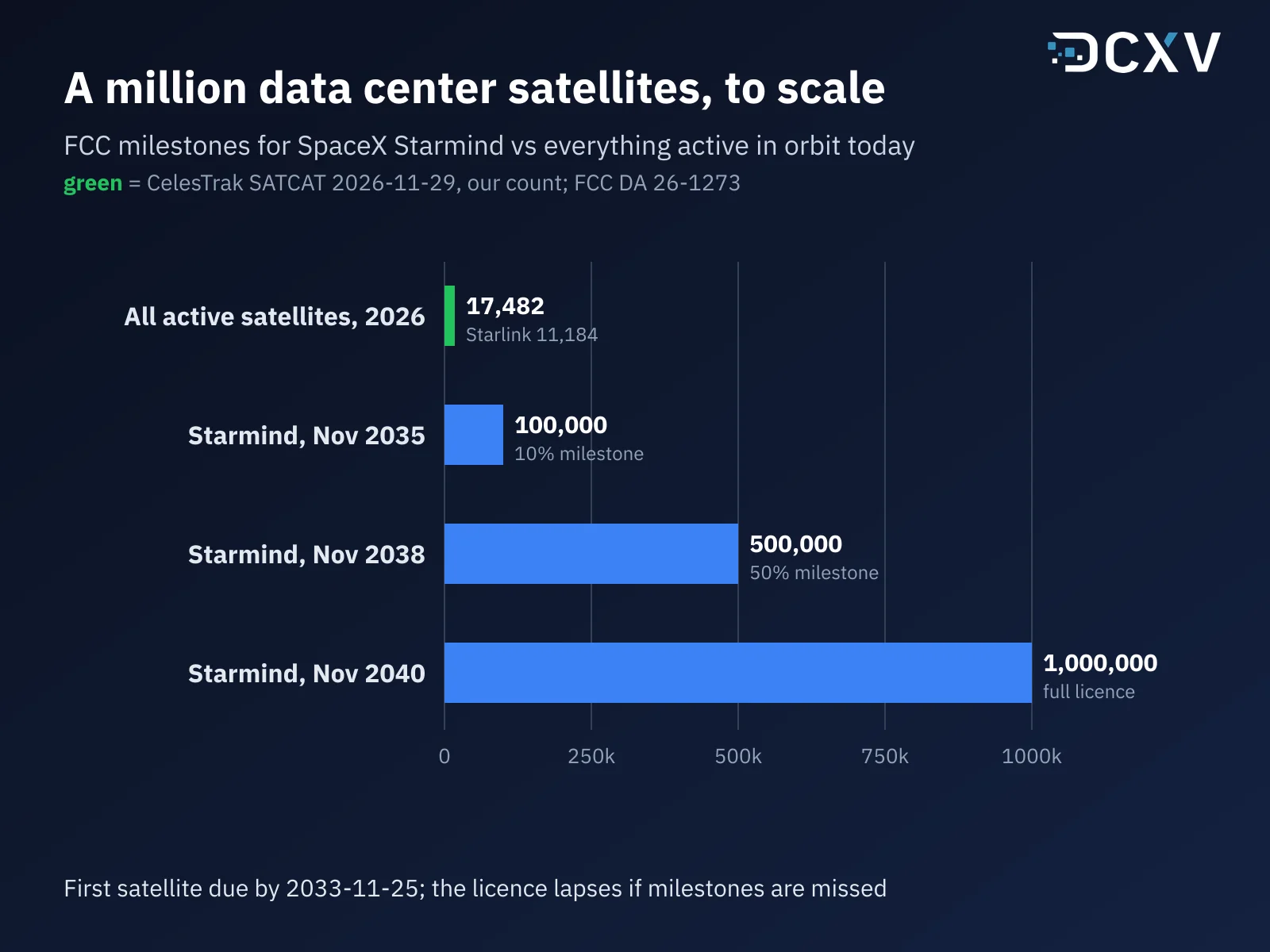
Short answer (checked 2026-11-29): On 25 November 2026 the US Federal Communications Commission (FCC) authorised SpaceX's "Starmind" system: up to 1,000,000 satellites that act as orbital data centers, in shells from 500 to 1,002 km. It is a licence with deadlines, not a launch schedule. The first satellite is due by 25 November 2033 and the full million by 25 November 2040; parts of the plan, including debris disposal above 600 km, still need separate approval. In our own count of the public satellite catalogue, 17,482 satellites are active in orbit today, so the licence covers 57 times everything now working up there. For anyone buying servers in the next few years, nothing changes yet. What the decision does show is how scarce ground capacity has become: power, chips and permits.
Sources. FCC order DA 26-1273, "SpaceX Orbital Data Center System (Starmind)", file SAT-LOA-20260108-00016, call sign S00798, adopted and released 2026-11-25 (text); FCC news release of the same day; CNBC and NBC News / Reuters 2026-11-25, Engadget 2026-11-26; the Washington Post story and the Hacker News thread that brought it to our attention. Satellite data: CelesTrak SATCAT, downloaded 2026-11-29 07:02 UTC.
What the FCC actually approved
- Scale and orbits. One non-geostationary constellation of up to 1,000,000 satellites in shells about 50 km thick between 500 and 1,002 km. The cover page lists six groups: 550-568 km at 26-32 degrees, 565-585 km at 97.7, 686-718 km at 30, 707-744 km at 97.2, 946-978 km at 30 and 967-1,002 km at 99.4 degrees.
- What they do. The FCC calls them "orbital compute modules" that process data for use on Earth. SpaceX told the FCC the satellites run on "near-constant solar power". The order states no power or compute figure per satellite.
- Connectivity. The satellites rely on optical (laser) links, including links to SpaceX's Starlink constellations. Radio is only a backup for telemetry, tracking and command, in 18.8-19.3 GHz down and 28.6-29.1 GHz up, on a non-interference basis, through licensed Starlink gateway stations.
- Milestones. One satellite operating by 25 November 2033, 10% (100,000) by 25 November 2035, 50% by 25 November 2038, the rest by 25 November 2040. Missing a milestone voids the authorisation. The licence term is 15 years from the first satellite.
- Waivers. No surety bond, no processing-round priority (SpaceX must coordinate with other operators), and new milestone rules in place of the standard ones.
What is still open
- Debris above 600 km is deferred. The FCC accepted the debris plan for satellites below 600 km. For anything higher, and for any satellite that would not re-enter the atmosphere after its mission, SpaceX must file a separate modification first. SpaceX says it will test at lower altitudes before moving up.
- Objections. Amazon's Kuiper (Amazon Leo), Viasat and the American Astronomical Society filed petitions to deny. Concerns outside the FCC's authority, including environmental effects and optical astronomy, were dismissed on that ground; Earthjustice criticised the lack of an environmental review.
- Launch. Reuters notes the plan depends on cheaper launches with Starship, still in development. Musk has said launches would start in 2027; that is his statement, not part of the order.
- Competition. The FCC says it is reviewing other orbital data center proposals; CNBC reports Blue Origin asked for up to 51,600 satellites ("Project Sunrise").
Our own data: a million against today's sky
We ran our own script over the CelesTrak satellite catalogue (every tracked object, with its status, orbit and launch date). Output, run on a DCXV Cloud server with Bun 1.4.4 on 2026-11-29:
SATCAT rows 71472, file 2026-11-29T07:02Z
Earth orbit now: 35294 objects (payloads 20439, rocket bodies 2307, debris 12540, unknown 8)
active payloads 17482; Starlink active 11184 (64.0%)
mean altitude 500-1002 km: 11873 objects, 2967 active payloads, Starlink 138, debris 7337
1,000,000 / active payloads = 57.2x; / objects in band = 84.2x
payloads launched 2025-11-29..2026-11-29: 4316, Starlink 2639
years to 100,000 at that Starlink rate: 37.9; to 1,000,000: 378.9
100 km shells (all objects / active payloads):
  400-499: 10942 / 10720
  500-599: 2186 / 1664
  600-699: 2044 / 769
  700-799: 2743 / 196
  800-899: 2854 / 136
  900-999: 1576 / 193
How to read it:
- Starmind's band is the debris band. Between 500 and 1,002 km there are 11,873 tracked objects, but only 2,967 are working satellites; 7,337 are debris. Most active Starlink satellites now sit lower, at 400-499 km. That is why the FCC split the debris question at 600 km.
- The milestone needs a new launch rate. In the last 12 months 2,639 Starlink satellites were launched. To reach 100,000 Starmind satellites by November 2035, SpaceX would need about 11,100 a year for nine years, roughly 4.2 times that pace, on top of Starlink (our arithmetic; Starship would carry more per launch, so this is a rate, not a forecast).
- Limits. "Active" is CelesTrak's status code; the catalogue lists tracked objects only, and mean altitude hides elliptical orbits.
Physics a buyer can check: delay and shade
The same script also computed the geometry, and we measured network round trips from our server in Prague with a TCP connect test (20 tries each):
| Path | Round trip | How we got it |
|---|---|---|
| Ground to a satellite at 550 km overhead and back | 3.67 ms | Light time, computed |
| Same at 25 degrees above the horizon (1,123 km away) | 7.49 ms | Light time, computed |
| Ground to 1,002 km at 25 degrees | 12.62 ms | Light time, computed |
| Prague to Frankfurt over fibre | 7.5 ms min, 7.8 median | Measured, 2026-11-29 |
| Prague to London over fibre | 18.2 ms min, 19.2 median | Measured, 2026-11-29 |
Light time alone is the floor. A real request would also cross Starlink, the laser links between satellites and a ground gateway, and none of those delays is stated in the order. So an orbital data center can be close in pure distance, but it is not a low-latency option for a European web shop or database; it suits large batch jobs such as AI training, where seconds do not matter. Our memory latency measurements show how much more nanoseconds inside a server matter for those jobs.
Shade matters too. A satellite at 550 km circles the Earth every 95.5 minutes, and in an orbit facing the Sun edge-on it spends up to 37.2% of each turn (35.6 minutes) in the Earth's shadow. The 97-99 degree shells are near-sun-synchronous inclinations, where a dawn-dusk orbit can stay in sunlight most of the time; the 26-32 and 30 degree shells cannot, so they need batteries or idle time. The order does not say which planes SpaceX will use.
What it changes for server buyers now
- Nothing to buy yet. No satellite is required before 2033. Capacity you need in 2027-2030 will be on the ground.
- Read it as a signal of ground scarcity. Companies look at orbit because ground sites face power, memory and permit limits; see our notes on server RAM prices and on US voters rejecting data centers. Lock in capacity and prices you can get now rather than wait.
- Keep latency-sensitive work close to users. Web apps, databases and APIs for European users belong in a European data center a few milliseconds away, not behind several satellite hops.
- Ask where your data is processed and under which law. An orbital data center licensed in the US is US infrastructure; for EU personal data, a server in the EU is the simple answer.
- Plan for the batch jobs. If orbit ever becomes cheap compute, it will fit training and rendering first. Rent GPU servers for that today and keep your pipeline portable.
Compute you can use this week
Our Tier III data centers in Prague and Covilha run cloud servers, dedicated and GPU servers on our own network, AS204057, under EU law. They are ready in minutes, not by 2033. Tell us what you need to run at sales@dcxv.com and we will suggest a setup.