Air Force Cloud One Breach: Lock Down Your Control Plane
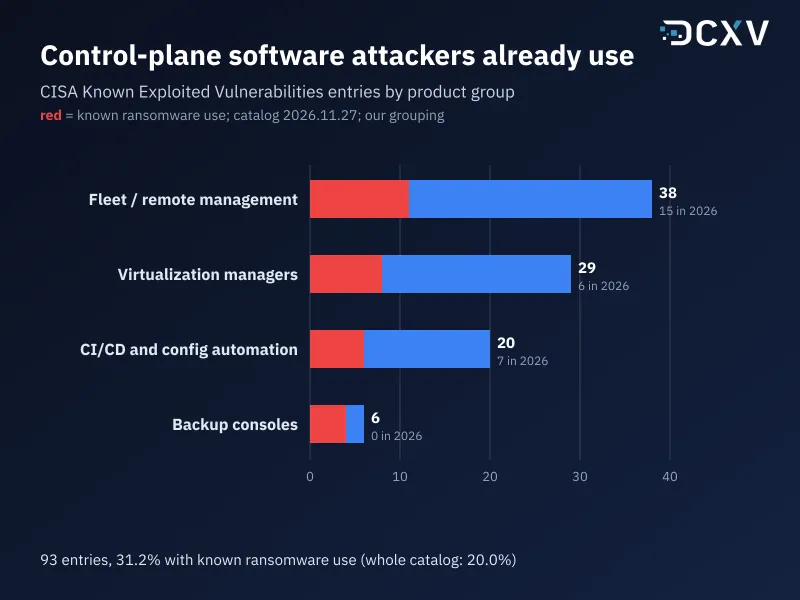
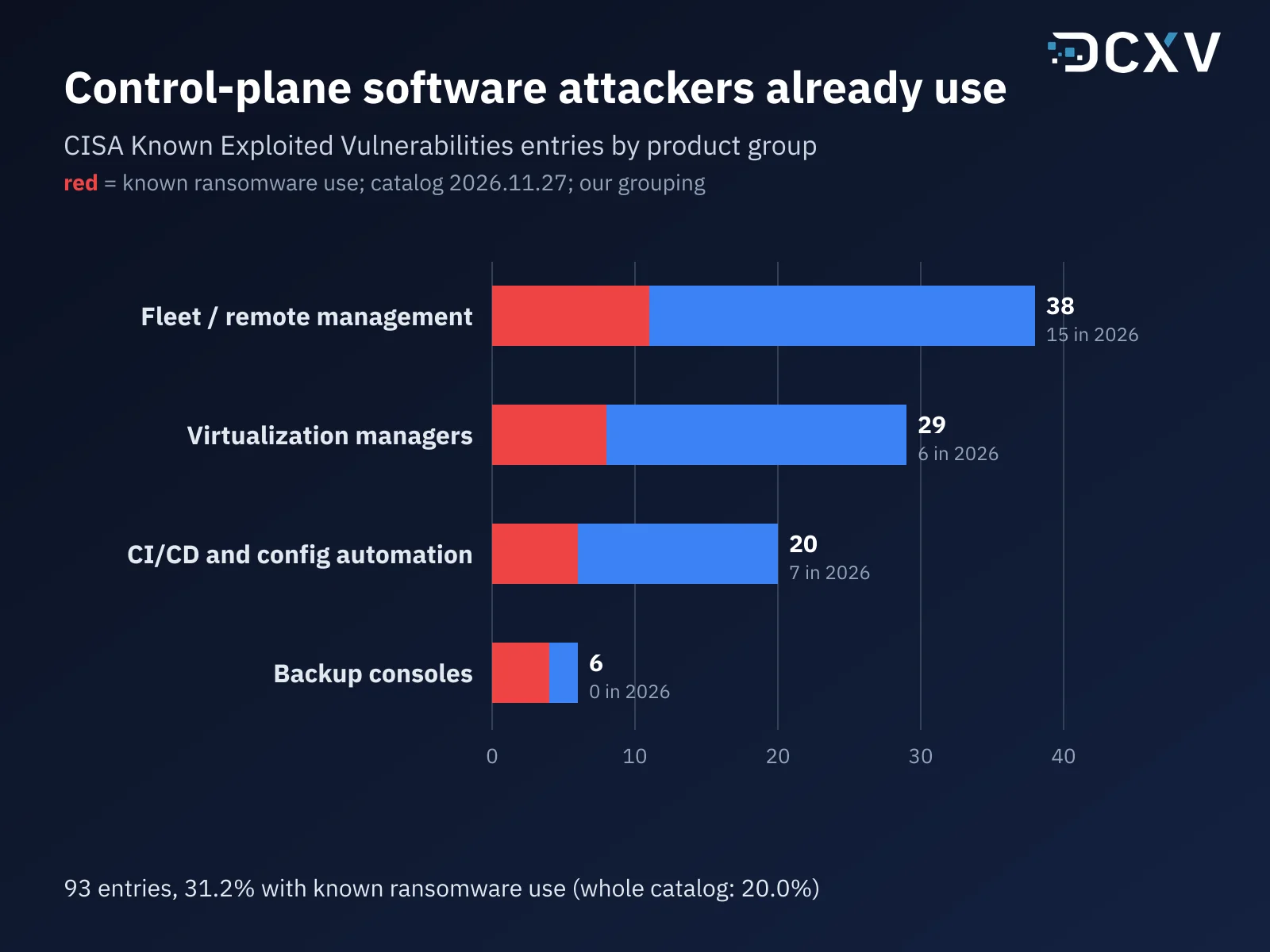
Short answer (checked 2026-11-28): Reuters reported on 27 November 2026 that hackers breached Cloud One, the US Air Force's flagship cloud platform, which runs on Microsoft, Amazon, Oracle and Alphabet clouds. One source said the intruders "exploited a software vulnerability to reach the control plane", the layer that manages everything else. Who did it, how far they got and whether data left is not known. The lesson for any cloud or dedicated server customer is narrower than the headline: the management layer (provider panel, hypervisor manager, deploy pipeline, backup console) is the prize. In our own count of CISA's list of exploited vulnerabilities, products of that kind make up 93 entries, 31.2% of them with known ransomware use against 20.0% for the whole list, and 28 were added in 2026 alone.
Source. Reuters, "Hackers breach US Air Force flagship Cloud One computing platform", Mike Stone and Raphael Satter, 2026-11-27 (Reuters refuses automated reading; we read the full text in the Military Times and Spokesman-Review reprints), BleepingComputer the same day, Hacker News thread. CISA BOD 26-04 of 2026-06-10 and the KEV catalog, version 2026.11.27.
What is reported, and what is not
- The platform. Cloud One was started in 2017 as a "one-stop shop" for the Air Force's IT needs. It combines four operators, Microsoft, Amazon, Oracle and Alphabet, and two sources call it one of the US military's biggest cloud platforms. SAIC was the prime contractor until Leidos took over (the reprints disagree on the year: 2025 or 2026).
- What runs on it. Cloud-Based Command and Control, which collates air defence radar and other feeds from across North America; the Theater Integrated Combat Munitions System, which tracks bombs and missiles at more than 200 Air Force locations; and applications for personnel, pay, logistics and maintenance.
- How. One source: a software vulnerability gave the intruders the control plane, which the source compared to "a universal remote". Reuters could not identify the vulnerability.
- When. Found "within the past month or so" during work to upgrade the system.
- Impact so far. Migration of back-office applications to Cloud One is paused. Updates to applications already on it were blocked, so staff could not apply fixes while a new batch of serious vulnerabilities was being disclosed. Some users lost administrator rights. Cyber Command was called in to assess the damage.
- Official line. The Air Force "does not comment on the security posture, vulnerabilities or operational status of specific networks and systems".
- Unknown. The attacker, the full scope, and whether any data was stolen. No source says the four providers' own platforms were breached, and none links this case to the at least six other federal incidents disclosed recently.
Why the control plane is the prize
Your applications and data are the data plane. The control plane is whatever can create, reinstall, snapshot, copy, open a console on or delete the machines that run them. Whoever holds it does not need to break into each server: they press buttons. Cloud One shows the second cost too. Once the management layer itself was suspect, the normal path for shipping fixes was frozen, exactly when fixes were needed.
The same layers exist in a small setup, and each has a first control that limits it:
| Layer | What its holder can do | First control |
|---|---|---|
| Provider account or panel | Reinstall, delete, restore, open the console | Two-factor sign-in, one person per login |
| Hypervisor manager (vCenter, Proxmox, Xen Orchestra) | Copy any VM disk, power off everything | Management network only, behind a VPN |
| Fleet / remote management | Run commands on every machine | Patch in days, not weeks |
| CI/CD and config automation | Push code and config to every server | Protected branches, separate deploy keys |
| Backup console | Delete or encrypt every copy | One copy it cannot reach |
If you still run vCenter, our VMware migration guide covers the way out; vCenter alone has a CISA entry added as recently as 20 November 2026.
Our own data: control-plane software on CISA's exploited list
We ran our own script over CISA's Known Exploited Vulnerabilities catalog and grouped the products that manage other machines by vendor and product name (our grouping; remote-access gateways such as VPN appliances are left out). Output, run on a DCXV Cloud server with Bun 1.4.4 on 2026-11-28:
CISA KEV 2026.11.27 (2026-11-27T18:03:12.5733Z), 1808 entries
category | entries | added 2024 | 2025 | 2026 to date | known ransomware use
Virtualization managers | 29 | 5 | 4 | 6 | 8 (27.6%)
Fleet / remote management | 38 | 5 | 8 | 15 | 11 (28.9%)
CI/CD and config automation | 20 | 3 | 1 | 7 | 6 (30.0%)
Backup consoles | 6 | 1 | 2 | 0 | 4 (66.7%)
All control-plane rows above | 93 | 14 | 15 | 28 | 29 (31.2%)
Whole KEV catalog | 1808 | 186 | 245 | 324 | 362 (20.0%)
days from listing to CISA due date, median:
2024 control plane 21 (14) | catalog 21 (186)
2025 control plane 21 (15) | catalog 21 (245)
2026-01-01..06-09 catalog 14 (133), 33 with <= 3 days | control plane 14 (11), 4 with <= 3 days
2026-06-10..11-27 catalog 3 (191), 151 with <= 3 days | control plane 3 (17), 15 with <= 3 days
How to read it:
- A small slice, a favourite target. Control-plane products are 5.1% of the catalog, but CISA marks 31.2% of them as used in ransomware campaigns, against 20.0% overall. Backup consoles are only 6 entries, but 4 of them carry the ransomware flag, which fits the familiar pattern of destroying backups before encrypting.
- Growing faster than the list. 28 control-plane entries were added in 2026 to 27 November, against 15 in all of 2025 (+87%); the whole catalog grew 32% (324 vs 245).
- The clock is now three days. Since BOD 26-04 took effect on 10 June 2026, the median time between listing and CISA's due date is 3 days (151 of 191 new entries), against 14 days earlier in 2026 and 21 days in 2024 and 2025. 15 of the 17 control-plane entries since then had three days. The directive binds US federal civilian agencies only and excludes Department of War systems, so it says nothing about Cloud One; it is a fair yardstick for anyone else.
- Limits. KEV lists confirmed exploitation, not every bug, and our name-based grouping can miss products. "Known" ransomware use is CISA's flag, not a full count.
What to change in your own setup
- Give every person their own login with two-factor sign-in on your provider panel, registrar and DNS. On our panel, two-factor sign-in (TOTP) is in the account settings, and resellers can give each client a sub-account instead of a shared password.
- Take management interfaces off the internet. Hypervisor managers, CI servers and admin panels belong on a private network reached through a VPN server, not on a public IP with a password.
- Patch the management layer first, within days. It holds the keys to everything else; three days is the bar CISA now sets for its own agencies.
- Keep one backup copy the control plane cannot delete: another account, another provider or offline media, and test the restore as in our backup and restore guide.
- Have a patch path that does not depend on the platform. If your pipeline is frozen during an investigation, you need SSH keys and console access to fix hosts by hand, documented before the day you need them.
- Send audit logs somewhere the admin account cannot erase, so an investigation has a timeline. Our Microsoft outage analysis makes the same point for incident tools: keep them off the platform that fails.
A short chain of control
Our Tier III data centres in Prague and Covilha run cloud servers and dedicated servers on our own network, AS204057, with a client panel that supports two-factor sign-in and backup plans you set per server. A small server outside your main platform is also a good home for logs, a VPN entry point and the backup copy no one else can reach. Tell us what you need to separate at sales@dcxv.com and we will suggest a setup.