SSD Prices May Fall in 2027: What Server Buyers Should Do
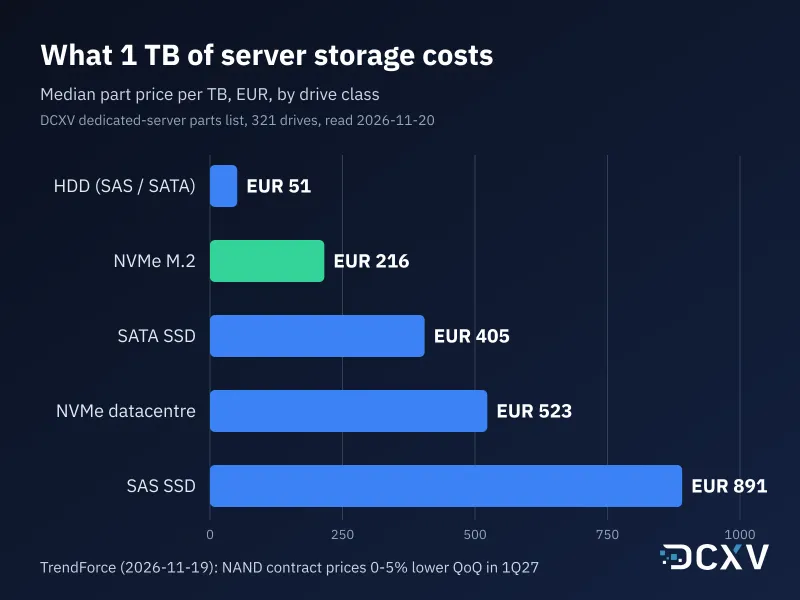
Short answer (checked 2026-11-20): After more than a year of steep rises, the first forecast of falling flash prices is out. TrendForce expects overall NAND flash contract prices to drop 0-5% quarter on quarter in 1Q27, with every product category declining from 2Q27, because Chinese cloud providers cut their 2027 enterprise SSD orders. A dip of 0-5% after a run-up of this size changes little for a server you need this quarter. What does change your bill is the kind of drive you pick: in our own parts list, a terabyte on a SAS SSD costs about four times as much as on an NVMe M.2 drive.
Source. The topic reached Hacker News on 2026-11-19 (304 points, 230 comments) as "SSD prices may begin to decline in the latter half of 2027", linking a DriveVault blog post of 2026-09-17. The newer forecast is TrendForce's press release of 2026-11-19, reported the same day by The Register.
What changed this week
TrendForce's release says Chinese cloud providers, facing GPU shortages, high inventory and competition over AI token pricing, cut their total 2027 enterprise SSD orders by more than the extra demand from US cloud providers, who have raised their own 2027 forecasts again. Supply keeps growing: NAND bit output is projected to rise 25-30% in 2027 and industry capex 26.7% to US$29.9 billion. The same release lowers the 4Q26 contract-price rise to 8-13%, from the 15-20% TrendForce gave on 2026-09-30, and notes a correction of more than 20% in spot prices.
The DriveVault post that the thread linked is a vendor blog written two months earlier, but its retail figures are a useful dated picture. Quoting ComputerBase's check of German retail prices on 2026-09-16, a Kingston NV3 1 TB went from EUR 50 to EUR 144 in a year (+189%) and a Samsung 990 Pro 4 TB from EUR 285 to EUR 609 (+114%). Its forecast, SSDs easing in the second half of 2027, now sits a quarter or two behind TrendForce's.
How far enterprise SSD prices climbed
Datacentre drives rose faster than consumer ones. TrendForce's quarterly enterprise SSD contract-price figures, as published:
| Quarter | Enterprise SSD contract price, QoQ | TrendForce, published |
|---|---|---|
| 4Q25 | more than +25% (forecast) | 2025-12-05 |
| 1Q26 | about +80% | 2026-06-11 |
| 2Q26 | +48-53% | 2026-04-24 |
| 3Q26 | +20-25% | 2026-07-29 |
| 4Q26 | +15-20% | 2026-10-30 |
Chained at the low end of each range, that is about 4.6 times the 3Q25 level by the end of 2026 (our arithmetic on a mix of forecasts and reports, not a TrendForce figure). Against that, 0-5% in 1Q27 is small. TrendForce expects the declines to deepen through 2027, but even several quarters of them leave flash far above its 2025 price.
Our own data: what a terabyte costs by drive class
We ran our own script over the public parts list behind our dedicated server configurator (324 drive entries, 321 with a readable size of 200 GB or more), grouping drives by class and computing EUR per TB of the part price. The last column is what one terabyte adds to the configured monthly price under our formula (part price spread over 10 months, times the 1.2 margin, excl. VAT).
Output, run on a DCXV Cloud server with Bun 1.4.4 on 2026-11-20:
parts read      324 (DRIVE + NVME), used 321, skipped 3 (no size / < 200 GB)
class                      n   min EUR/TB  median EUR/TB  median rent add EUR/TB/mo
HDD (SAS / SATA)          140     24.74        51.39            6.17
SATA SSD                   42    104.16       405.01           48.60
SAS SSD                     7    549.61       890.89          106.91
NVMe M.2                   94    124.56       215.72           25.89
NVMe DC (U.2/E1/E3/AIC)    38    100.00       523.22           62.79
SSD median EUR/TB by size: < 1 TB 312.47 (49), >= 3.84 TB 312.50 (47)
cloud SSD (Prague rate 0.01578 EUR/GB x 1.2)  18.94 EUR/TB/mo, no backup copy
How to read it:
- NVMe M.2 is the cheapest flash per terabyte in our list, a median of EUR 216: about half of SATA SSD and a quarter of SAS SSD. Most of these M.2 drives are client models: fast, but without power-loss protection and with lower endurance ratings than datacentre U.2 or SAS drives. Use them in mirrored pairs for data you can rebuild, not as the only copy of a write-heavy database.
- Bigger drives are not cheaper per terabyte here. The SSD median is EUR 312 per TB below 1 TB and EUR 312 at 3.84 TB and up, so buy the size you need.
- HDDs stay about four times cheaper per terabyte than the cheapest flash class, so bulk data, backups and archives still belong on spinning disks; our backup and storage packages are built for that.
- In the cloud, disk is a rate, not a part. Our Prague rate works out at EUR 18.94 per TB a month excl. VAT. On our published plans, 40 GB more disk on the same 4 vCPU / 8 GB server (Medium EUR 18.43 vs the CI runner package EUR 19.96) costs EUR 1.53 a month, its weekly backup copy included.
What to do with a forecast like this
- Do not postpone a server you need now. The first forecast drop is 0-5%, and enterprise SSD is the category that held up longest. Waiting two quarters to save a few percent on drives usually costs more than it saves.
- Size storage to a measurement, then grow. On a cloud server you can attach up to four extra disks, from 10 GB each, when you need them. Watch
df -hand the growth of your data for a week before choosing; per-workload rules are in our cloud server sizing guide. - Pick the drive class by workload. Write-heavy databases want datacentre NVMe with power-loss protection; read-mostly web and application data runs well on mirrored M.2; backups go to HDD.
- Keep RAM in view. The Register's report on the forecast notes that cheaper flash will not resolve the separate DRAM squeeze. What memory costs on our plans is in Altman wants your DRAM in data centers, and a full build in what a 64 GB RAM server costs.
Build at today's prices, with the right mix
Our Tier III data centres in Prague and Covilha run cloud servers whose disks you can grow later; dedicated servers are built in Prague from the parts in the list above at today's part prices. Send your capacity and write load to sales@dcxv.com and we will suggest a drive mix.