How Much Does a Dedicated Server Cost Per Month
Dedicated server pricing spans a wide range depending on hardware configuration, location, and the provider you choose. In 2026, monthly costs run from around EUR 50 for entry-level machines to over EUR 500 for enterprise-grade hardware with NVMe storage and high-bandwidth uplinks.
Price Ranges by Tier
Budget tier (EUR 50-120/month): Entry-level dedicated servers in this range typically include older-generation Intel Xeon processors (E3 or E5 family), 16-32 GB of DDR4 RAM, 1-2 TB HDD or a small SSD, and a 100 Mbps or 1 Gbps shared uplink. These are suitable for small applications, development environments, or single-purpose workloads. Provisioning at budget providers can take 24-72 hours.
Mid-range tier (EUR 120-300/month): This bracket covers modern multi-core processors such as AMD EPYC or Intel Xeon Scalable, 64-128 GB RAM, NVMe SSD storage in RAID, and a 1 Gbps guaranteed uplink. These servers handle production databases, mid-size e-commerce platforms, and media streaming without breaking a sweat. DCXV dedicated servers start from EUR 210/month and are provisioned in under 24 hours.
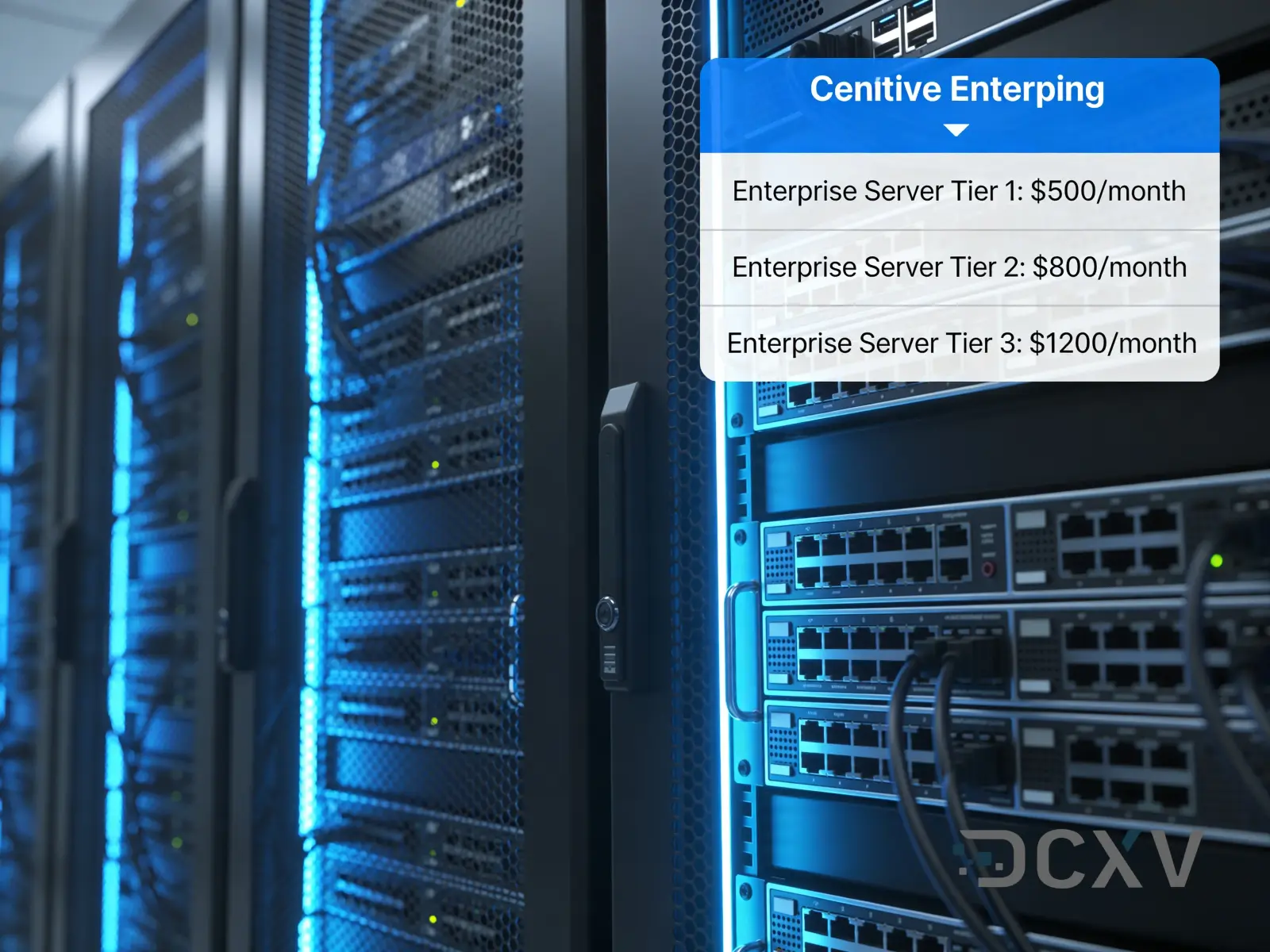
Enterprise tier (EUR 300-500+/month): High-core-count CPUs (32+ cores), 256 GB+ RAM, all-NVMe storage arrays, 10 Gbps uplinks, and SLA-backed uptime define this tier. Suitable for large SaaS platforms, financial applications, and workloads requiring predictable low-latency performance.
What Drives the Cost
The main cost levers for a dedicated server are:
- CPU generation and core count - newer AMD EPYC and Intel Sapphire Rapids chips carry a premium over older Sandy Bridge or Ivy Bridge hardware.
- RAM capacity - DDR4 ECC vs DDR5, and quantity (32 GB vs 256 GB) significantly affect price.
- Storage type and capacity - NVMe is 2-3x more expensive than SATA SSD, which is already more expensive than spinning HDD.
- Network bandwidth and uplink speed - unmetered 1 Gbps vs metered 10 Gbps can double or triple the base cost.
- Location - EU data centers (especially Germany, Netherlands, France) are competitive; North American pricing tends to run 20-40% higher for equivalent hardware.
- Support tier - managed services with 24/7 support carry a significant premium over unmanaged hardware rental.
Price Comparison Table
| Provider | Entry Config | Monthly Price | Provisioning | Location |
|---|---|---|---|---|
| DCXV | Xeon, 32 GB RAM, NVMe | from EUR 210 | under 24 h | Czechia / Portugal |
| Hetzner | Intel, 32 GB RAM, HDD | from EUR 43 | 1-7 days | Germany / Finland |
| OVH | Intel, 32 GB RAM, SSD | from EUR 55 | 24-72 h | France / UK |
| Contabo | Intel, 32 GB RAM, HDD | from EUR 36 | 3-5 days | Germany |
| AWS (c5.4xlarge) | 16 vCPU, 32 GB RAM | from EUR 250 | minutes | Multi-region |
DCXV Dedicated Server Pricing
DCXV operates Tier III data centers in Czechia and Portugal, all under Cyprus jurisdiction for GDPR compliance. Dedicated servers come with 24/7/365 support and an average response time of around 10 minutes. The facility uptime SLA is 99.982%, and the service SLA is 99.982%.
Provisioning is completed in under 24 hours for dedicated hardware, and the network runs on AS204057 with low-latency transit to major European exchanges. For cloud VPS instances, provisioning is under 10 minutes from order.
Prices start from EUR 210/month for dedicated configurations and EUR 15/month for cloud VPS. Contact sales@dcxv.com for custom hardware quotes, or start directly at https://dcxv.com/data-center#dedi.
Hidden Costs to Watch For
Many providers advertise a low base price but add charges that significantly increase the real monthly bill:
- Setup fees - one-time charges of EUR 20-100 are common at budget providers.
- IP address fees - additional IPv4 addresses often cost EUR 1-3 each per month.
- Bandwidth overages - providers with metered traffic charge per GB above the included allowance.
- Backup storage - automated off-server backups are rarely included in the base price.
- OS licensing - Windows Server licenses add EUR 15-40/month on top of hardware costs.
- Remote hands - physical intervention at the data center (KVM, hardware swap) may be billed per incident.
DCXV charges none of the above: no setup fee, no installation charge, and no per-GB overage on the included bandwidth allowance. Always request a fully itemized quote before signing, and confirm whether the advertised price includes VAT or is net.