How Much Are IPv4 Addresses Worth 2026
IPv4 addresses are a finite resource. The global pool of approximately 4.3 billion addresses reached exhaustion at the IANA level in 2011 and at most RIR levels by 2020. Since then, all new IPv4 acquisitions occur through the secondary market - organizations buying from others who hold more than they need. In 2026, that market is active, liquid in most block sizes, and pricing reflects genuine scarcity.
Price Ranges per IP We Saw in April 2026
| Block | IPs | RIPE Range/IP (April 2026) | ARIN Range/IP (April 2026) | APNIC Range/IP (April 2026) |
|---|---|---|---|---|
| /24 | 256 | $40-$54 | $42-$58 | $35-$50 |
| /22 | 1,024 | $38-$52 | $40-$55 | $33-$47 |
| /20 | 4,096 | $36-$50 | $38-$52 | $31-$45 |
These are the ranges DCXV's own brokerage deal flow recorded in April 2026, not a quote and not a present-day price. What a block actually trades for depends on its cleanliness, its routing history and demand at the moment of the deal - for the live picture see IPv4 pricing.
Price Trend 2022-2026
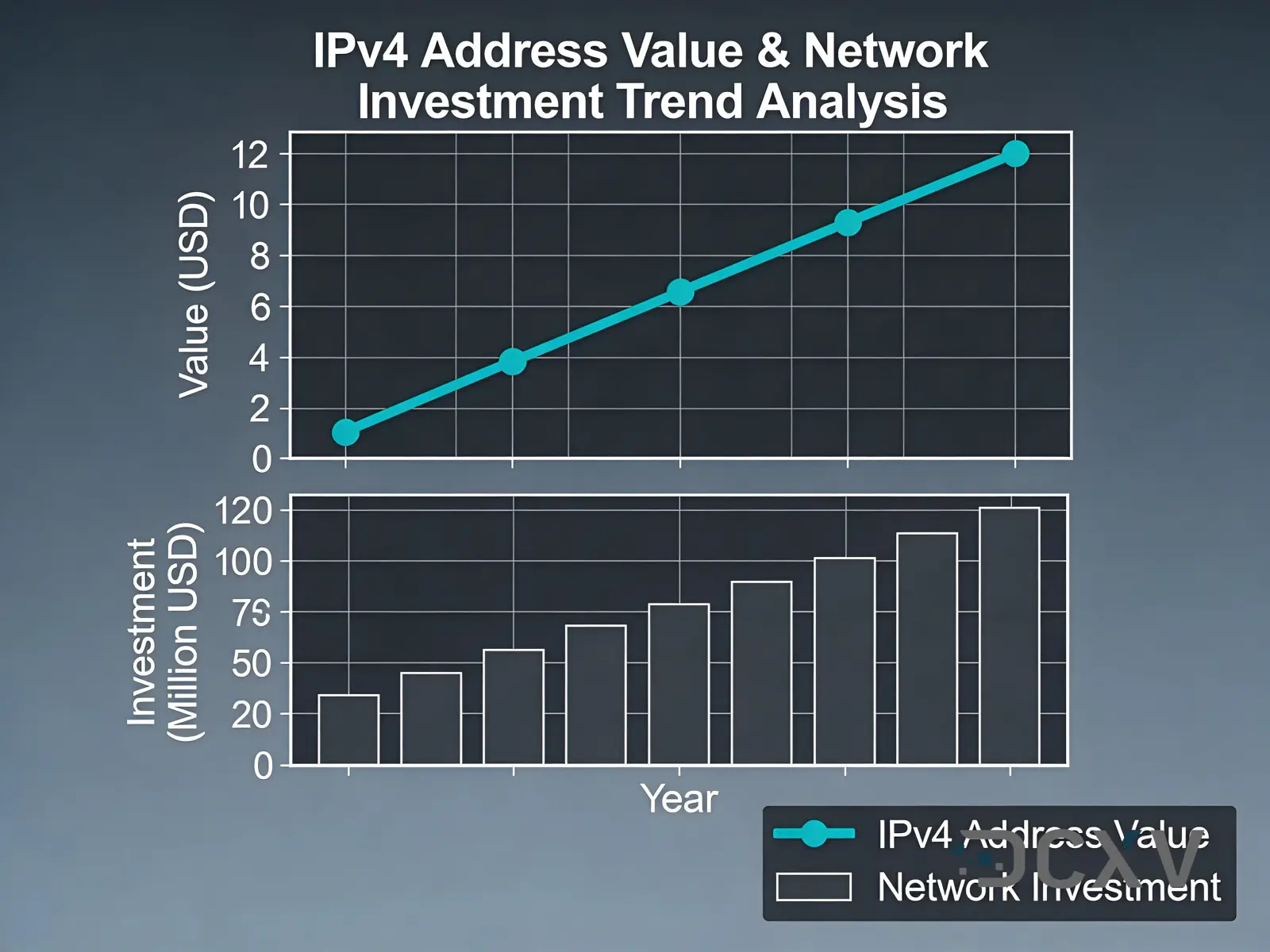
IPv4 address values have appreciated significantly over the past decade. In 2015, a /24 block could be purchased for $5-$10 per IP. By 2019, prices had climbed to $18-$25. The 2020-2021 period saw rapid appreciation driven by remote work expansion and cloud adoption, pushing prices past $50 per address at peak.
Post-peak correction from 2022-2023 settled prices in the $36-$46 range. The current 2024-2026 period has seen gradual recovery driven by AI infrastructure demand, persistent IPv6 deployment delays, and continued growth in mobile and IoT networks requiring IPv4 for interconnect and NAT breakout scenarios.
What Affects IPv4 Address Worth
Block size - Larger blocks carry slightly lower per-IP valuations due to a smaller buyer pool and higher absolute transaction cost. /24 blocks are the most liquid and closest to spot-market pricing. /16 and larger blocks are negotiated privately.
Region - ARIN-registered addresses command the highest global valuations, driven by US cloud and data center demand. RIPE NCC space is close behind. APNIC space is valued lower but rising with Asia-Pacific internet growth.
Utilization history - A block that has been actively used, has accurate WHOIS records, and shows consistent BGP routing history is worth more than equivalent dark space. Documented utilization supports clean title transfer and reduces buyer due diligence time.
Routing history - The single most impactful factor after region. A block that has never appeared on abuse, spam, or BGP hijack reports is worth materially more than one with any flag in its history. Buyers increasingly commission third-party routing reputation audits before completing purchases.
Price Difference: RIPE vs ARIN vs APNIC
ARIN blocks are typically worth 5-15% more than comparable RIPE NCC blocks and 10-25% more than APNIC blocks. The ARIN premium reflects concentrated demand from US-based hyperscalers and the stricter transfer process which provides title assurance to buyers. RIPE offers the best combination of price and liquidity for European buyers. APNIC offers the best value for Asia-Pacific-focused buyers.
How to Get a Current Quote
If you hold IPv4 addresses and want to know what they are currently worth, or if you want to acquire IPv4 space and need current market pricing, DCXV can provide an assessment. We review block size, region, WHOIS accuracy, routing history, and current market demand to give you a realistic valuation range.
DCXV operates as an IPv4 transfer broker for the RIPE NCC, APNIC and ARIN regions, with offices in Czechia and Portugal. Contact us at ipv4@dcxv.com for a free block valuation or purchase inquiry. https://dcxv.com/ipv4/pricing