AWS vs Dedicated Server: True Cost Comparison Europe
AWS is the dominant cloud provider globally, but for European workloads the total cost of running on AWS often surprises teams when they first audit their bills. This guide provides a clear comparison between AWS and dedicated server infrastructure, focusing on actual costs for European businesses.
Key differences
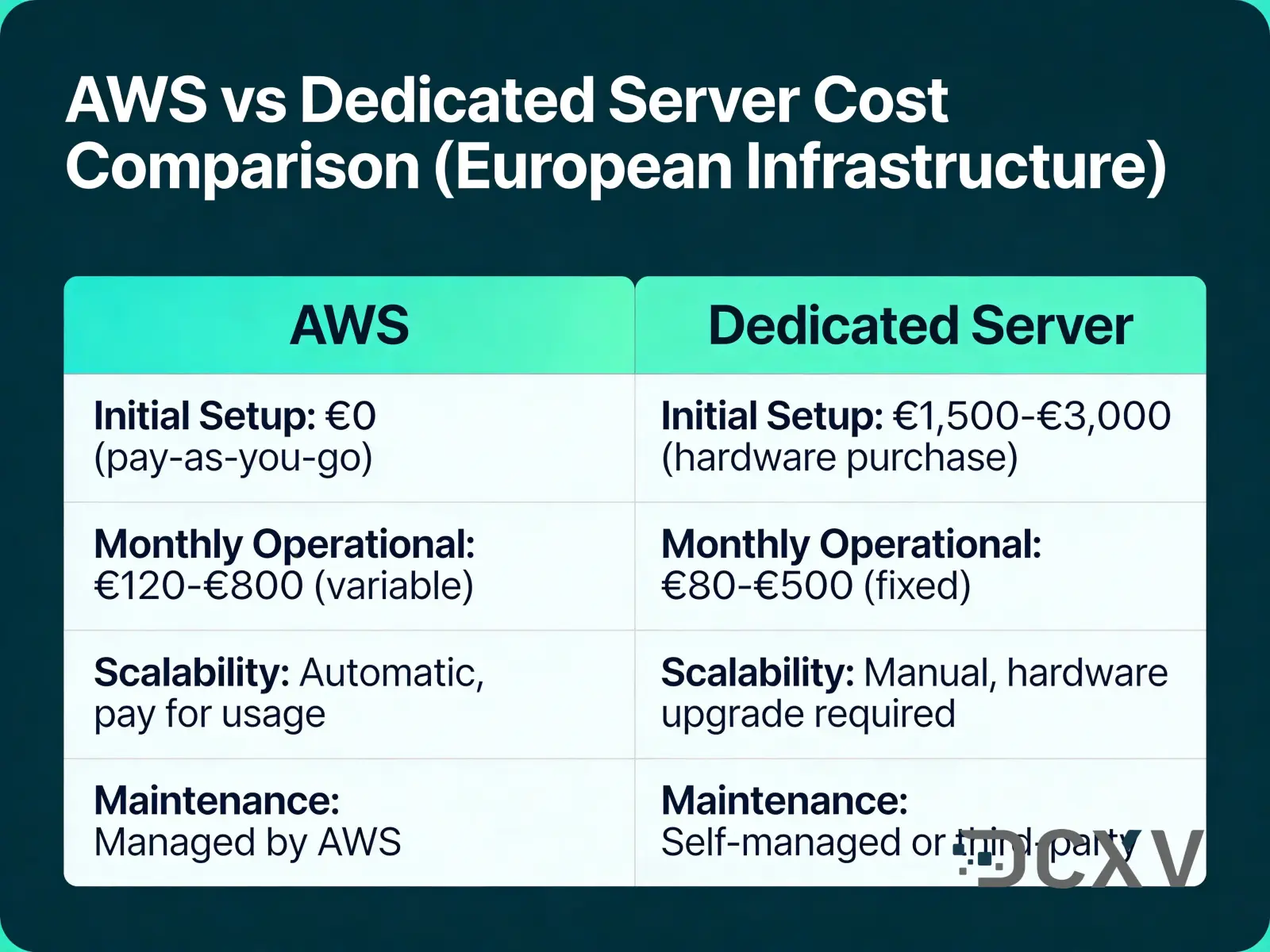
| Factor | AWS (Europe regions) | Dedicated Server (Europe) |
|---|---|---|
| Compute pricing | Per-hour, on-demand or reserved | Fixed monthly |
| Egress pricing | Charged per GB after free tier | Often included or flat-rate |
| Data sovereignty | AWS EU regions (Frankfurt, Ireland) | Country-specific options available |
| Provisioning | Minutes to hours | Under 24 hours |
| Support cost | Paid tiers start at significant monthly cost | Included with DCXV |
When to choose AWS
AWS offers undeniable advantages for specific use cases. The breadth of managed services - databases, queuing, machine learning APIs, and deployment tools - reduces operational overhead significantly when your team lacks dedicated infrastructure specialists.
AWS makes strong sense when:
- Your application depends heavily on AWS-specific managed services
- You need global multi-region deployment across many continents
- Your traffic is highly unpredictable with large variance
- You want to avoid any hardware management responsibility
For startups using AWS startup credits, the comparison also changes. Free credit programs can offset early-stage costs substantially.
When to choose dedicated server
The economics of AWS become less favorable as workloads mature and scale. The main cost drivers that make dedicated servers attractive for European businesses:
Egress costs: AWS charges for data leaving their network. European businesses with high-bandwidth applications - video, large file transfers, analytics data exports - can face significant monthly egress bills. Dedicated servers at DCXV include network bandwidth without per-GB egress fees.
Reserved instance complexity: To get reasonable AWS pricing, teams typically need 1- or 3-year reserved instance commitments. These require upfront cost analysis and reduce flexibility. Dedicated server pricing is straightforward fixed monthly.
Right-sizing friction: AWS instance types require matching to workload carefully. Over-provisioning on AWS costs more than over-provisioning a dedicated server in many configurations because every resource is billed.
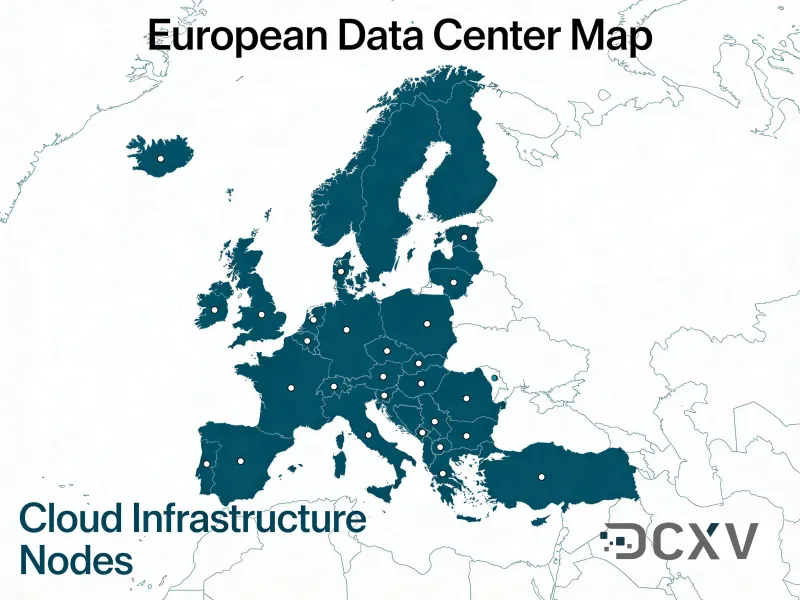
DCXV dedicated servers in Czechia and Portugal provide European data residency with straightforward pricing and 24/7/365 support at approximately 10-minute average response times.
Total cost of ownership comparison
A realistic TCO analysis for a medium-sized European web application with a persistent database typically shows:
AWS on-demand costs significantly more than reserved pricing. Reserved pricing requires commitment. Adding support, egress, and auxiliary services often increases the effective monthly cost by 20-40% above the raw instance price.
A dedicated server eliminates per-GB egress fees, provides physical hardware isolation, and includes a flat monthly cost. For workloads running continuously at predictable load, this model consistently delivers lower TCO beyond the first 12-18 months.
AWS advantages that partially offset cost:
- No capital expenditure, pure operating expense
- Instant scaling for traffic spikes
- Rich ecosystem of integrated services
Migration path
Migrating from AWS to dedicated infrastructure does not require abandoning all AWS services. A hybrid approach - dedicated servers for compute and storage, AWS for specific managed services like SES or CloudFront - is practical and common.
Migration considerations:
- Audit AWS bills to identify the highest-cost line items
- Identify workloads with predictable resource needs (database servers, API backends)
- Migrate stateful services first to dedicated, retain burst capacity on AWS if needed
- Validate latency between DCXV locations and your user base
DCXV data centers in Czechia provide excellent connectivity to central European users. Portugal serves southern European and Atlantic traffic well.
Explore DCXV dedicated server options
Comparing AWS to DCXV directly, rather than cloud versus your own dedicated hardware? See /alternatives/aws.