IPv4 /20 Block Price in 2026
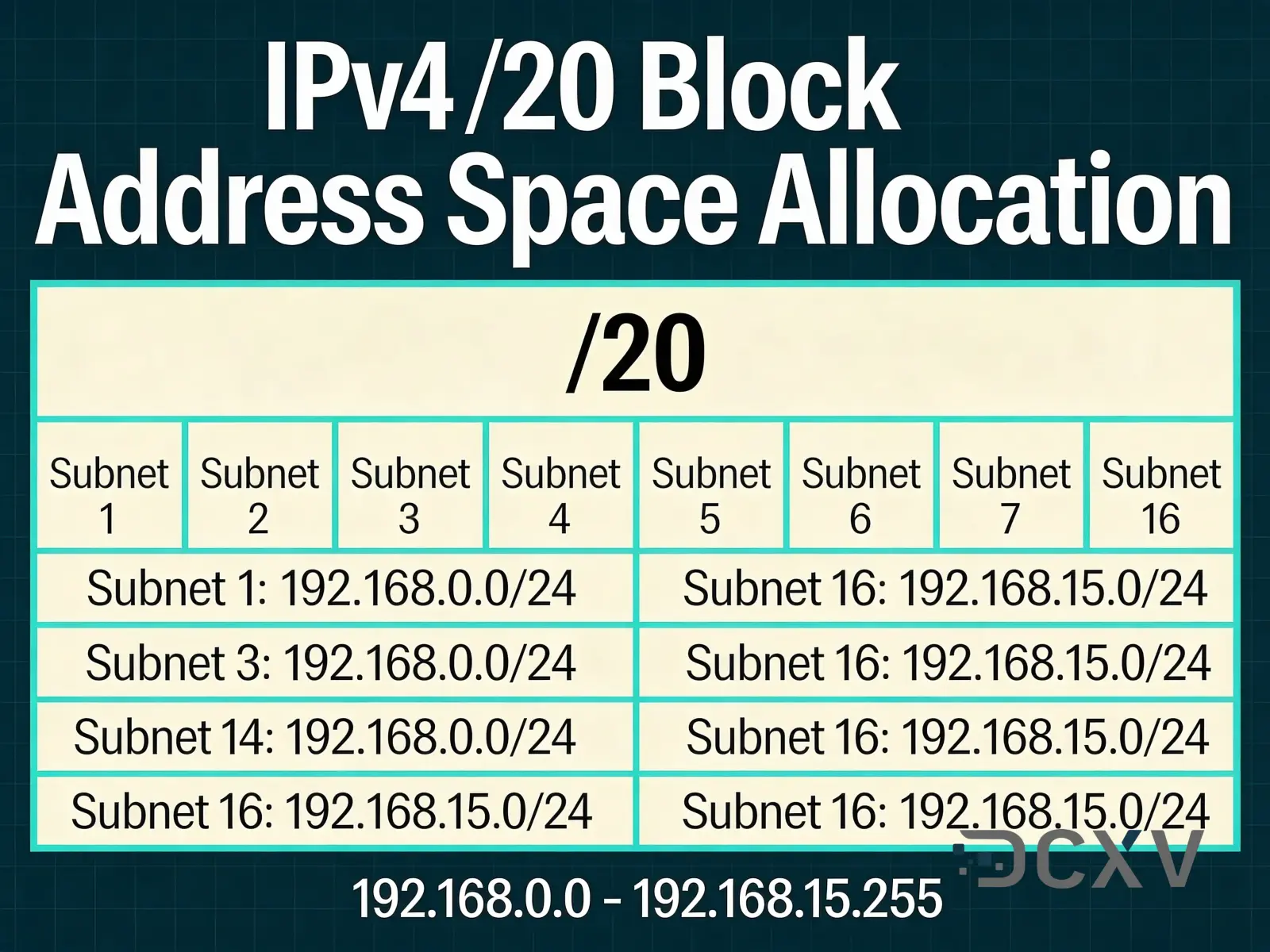
A /20 block contains 4096 IP addresses and is one of the most sought-after sizes for internet service providers, data centers, and cloud operators. At this scale, buyers are typically established operators who need a meaningful address allocation to support customer assignments, infrastructure growth, or new service regions.
Market Prices We Saw in April 2026
The /20 represents a significant commitment in both address space and budget. Per-IP pricing for /20 blocks is generally lower than for /24 blocks due to the volume discount inherent in larger transactions.
| Region | Block Size | Price Range (total block, April 2026) |
|---|---|---|
| RIPE NCC | /20 (4096 IPs) | $160,000 - $220,000 |
| ARIN | /20 (4096 IPs) | $170,000 - $235,000 |
| APNIC | /20 (4096 IPs) | $145,000 - $200,000 |
| LACNIC | /20 (4096 IPs) | $130,000 - $185,000 |
| AFRINIC | /20 (4096 IPs) | Contact for quote |
These are the ranges DCXV saw in its own brokerage deal flow in April 2026, not a quote and not a present-day price. What a block actually trades for depends on its quality, market liquidity and negotiation at the moment of the deal. The live source is IPv4 pricing; for an accurate quote, contact ipv4@dcxv.com. https://dcxv.com/ipv4/ripe/20
Price Trend 2022-2026
Large block transactions like /20 follow the same general trends as the broader IPv4 market but with some distinct characteristics. Fewer sellers hold /20 or larger blocks, which means supply is episodic. When a major institutional holder divests a /20, it can temporarily soften regional prices. Conversely, when demand spikes - such as during a cloud provider's expansion - /20 blocks can be absorbed quickly and prices firm up.
In 2022, /20 prices reached historic highs as cloud and CDN providers aggressively accumulated space. Through 2023 and 2024, the market normalized as some of these providers slowed acquisitions. In 2025 and into 2026, /20 prices are stable with occasional upward pressure from new telecom entrants in emerging markets.
What Affects /20 Block Price
Block contiguity: A clean, contiguous /20 that can be announced as a single prefix is worth more than a /20 assembled from eight separate /24 blocks, even if the total IP count is the same.
Routing history at scale: At the /20 level, routing reputation is scrutinized more carefully. ISPs and data centers deploying /20 space need to ensure the full block has a clean abuse history.
Registry region and policy: RIPE NCC /20 transfers involve a straightforward inter-RIR or intra-RIR process depending on buyer and seller. ARIN imposes needs justification requirements for new direct allocations, which makes the transfer market the primary route for most buyers.
Seller readiness: Large block sellers sometimes have complex organizational structures. Transfers involving corporate restructurings or estate sales can take longer and may affect pricing.
Timeline pressure: Buyers with urgent deployment timelines may pay a premium. ISPs launching new regions or data centers that have committed customer contracts cannot wait months for a block to become available.
Price Difference: RIPE vs ARIN vs APNIC
For a /20, the regional premium between RIPE and APNIC can be substantial - often $15,000 to $35,000 per block at the rates we saw in April 2026.
RIPE NCC /20 blocks are the gold standard for European ISPs and hosting operators. RIPE's transfer policy is well-documented and the process is predictable. Transactions typically require four to eight weeks from agreement to completion.
ARIN /20 blocks command the highest prices. The combination of needs justification requirements and strong North American demand keeps ARIN transfer market prices elevated. Buyers should expect detailed documentation requirements.
APNIC /20 blocks are suited for Asia-Pacific operators. Prices are more accessible, and APNIC's transfer process has become more streamlined in recent years.
How to Get a Current Quote
DCXV specializes in large block transactions. As an IPv4 transfer broker for the RIPE NCC, APNIC and ARIN regions, operating from Czechia and Portugal with AS204057, we have direct access to sellers and can match buyers with appropriate blocks efficiently.
For /20 acquisitions:
- Share your operational context (ISP, data center, cloud)
- Specify the registry region required
- Provide your target timeline
- Indicate if you need contiguous space or can accept assembled blocks
Contact ipv4@dcxv.com to begin the process. We handle due diligence, transfer paperwork, and escrow coordination for large block transactions. https://dcxv.com/ipv4/ripe/20