IPv4 Market Price History 2020-2026
Understanding IPv4 price history helps buyers and sellers make informed decisions about timing and valuation. This article traces the major price movements in the global IPv4 secondary market from 2020 through mid-2026, identifying the key drivers behind each cycle.
Market Prices We Saw in April 2026
| Region | /24 Range/IP (April 2026) | /22 Range/IP (April 2026) |
|---|---|---|
| RIPE NCC | $40 - $54 | $38 - $52 |
| ARIN | $42 - $58 | $40 - $55 |
| APNIC | $35 - $50 | $33 - $47 |
These are the ranges we saw in our own brokerage deal flow in April 2026, not a quote and not a present-day price. What a block actually trades for depends on its cleanliness, its routing history and demand at the moment of the deal. For what we publish today, see IPv4 pricing.
For a current quote, contact ipv4@dcxv.com. https://dcxv.com/ipv4
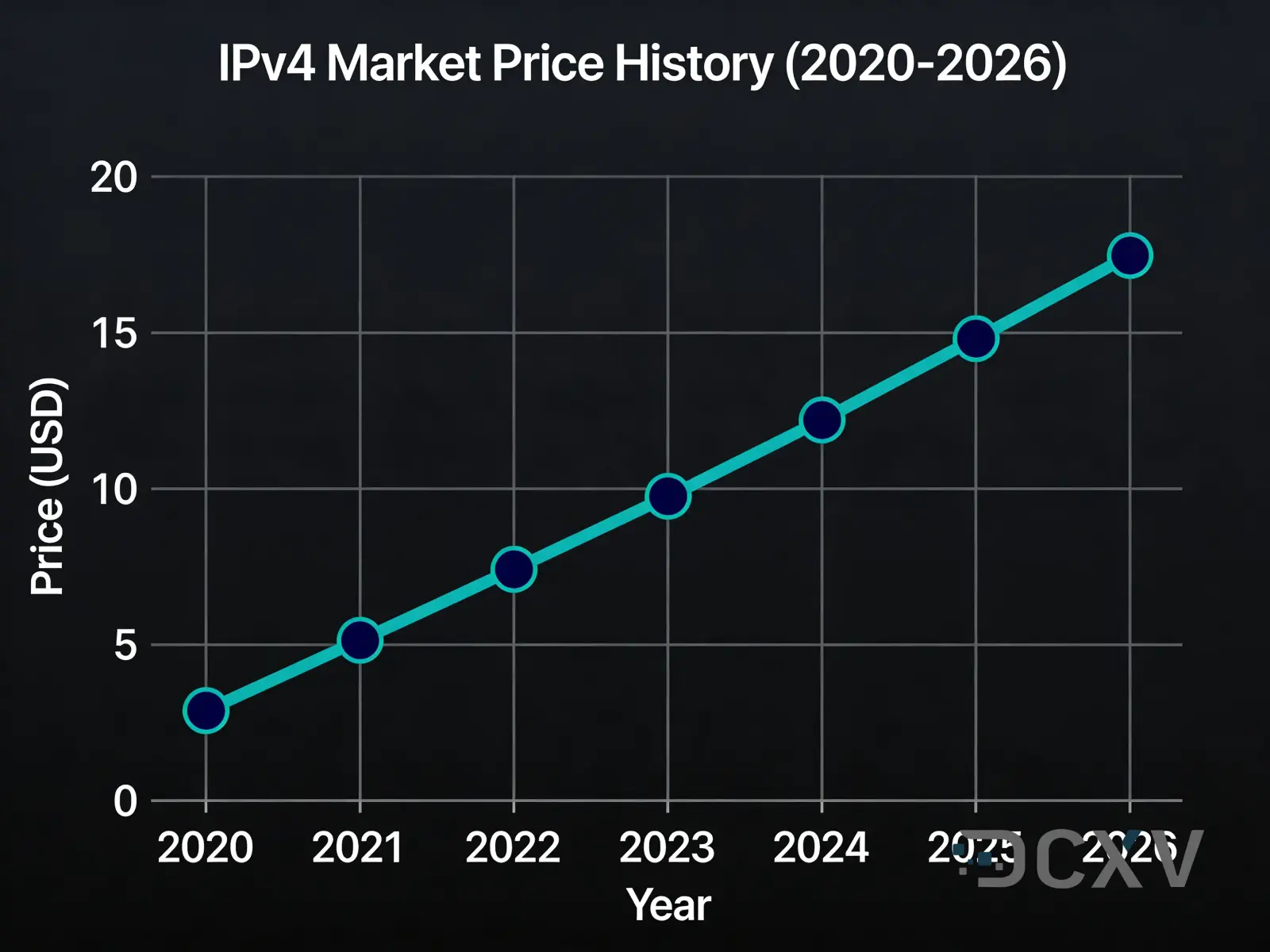
Price Trend 2022-2026
The market from 2020 to 2026 can be divided into four distinct phases.
Phase 1 - 2020: The COVID Acceleration
At the start of 2020, RIPE NCC /24 addresses traded in the $18-$25 range. The COVID-19 pandemic fundamentally changed network usage patterns. Remote work deployments created massive demand for VPN infrastructure, edge access points, and cloud-hosted services. Enterprise IT teams that had delayed IPv4 purchases suddenly needed address space urgently. This demand surge, combined with a restricted supply of clean blocks, pushed prices from $20 to over $35 per IP by end of 2020.
Phase 2 - 2021: The Peak
2021 saw the steepest appreciation in IPv4 address history. Hyperscaler and cloud provider growth continued at record pace. ARIN /24 blocks briefly touched $60-$65 per IP in mid-2021. RIPE NCC prices reached $50-$58. The combination of institutional buyers, private equity-backed IP investment vehicles, and genuine operational demand drove the market to levels that many observers considered unsustainable. Transaction volumes hit multi-year highs in Q2 and Q3 2021.
Phase 3 - 2022-2023: The Correction
By early 2022, the market showed signs of correction. Some institutional sellers who had purchased at lower prices began monetizing holdings. European telcos and legacy ISPs identified unused space and brought it to market. Transaction volumes remained elevated but per-IP prices fell 20-30% from peak. ARIN /24 blocks settled in the $40-$50 range. RIPE blocks fell to $36-$44. The correction was orderly rather than a crash, reflecting that underlying demand for IPv4 space remained genuine.
Phase 4 - 2024-2026: AI-Driven Recovery
The emergence of large-scale AI infrastructure as a major network consumer changed the demand picture significantly. GPU clusters, inference infrastructure, and AI training environments require substantial IPv4 space for management networks, API endpoints, and customer-facing services. This AI demand layer, added to continued cloud growth and persistent IPv6 transition delays, pushed prices upward through 2024 and 2025. In 2026, market prices have recovered to $38-$54 for RIPE /24 blocks and $42-$58 for ARIN, reflecting a market approximately 10-15% below 2021 peak levels but with upward momentum.
What Affected IPv4 Price
Block size - /24 blocks led price movements in both directions. Larger blocks followed with some lag and smaller per-IP movements.
Region - ARIN led the 2021 peak and the subsequent correction. RIPE NCC followed with a slight lag. APNIC showed the most stable pricing through the cycle, with smaller peak appreciation and shallower correction.
Utilization history - Throughout the entire 2020-2026 period, blocks with documented utilization history and clean WHOIS records consistently commanded 10-15% premium over equivalent dark space.
Routing history - BGP reputation became increasingly important as buyer due diligence improved. By 2024-2025, third-party routing reputation reports became a standard part of transaction documentation for blocks above /22.
Price Difference: RIPE vs ARIN vs APNIC
ARIN maintained a 5-15% premium over RIPE throughout the 2020-2026 cycle. This premium widened slightly during the 2021 peak when US cloud demand was most acute, and narrowed during the 2022-2023 correction. APNIC traded 10-20% below ARIN throughout, with the gap narrowing from 2024 onward as Asia-Pacific demand accelerated.
How to Get a Current Quote
DCXV has been active in the IPv4 transfer market through the full 2020-2026 price cycle. Our market knowledge covers transaction history, regional price differentials, and block-specific value factors. We serve both buyers entering the market now and sellers assessing whether current prices represent a good exit point.
Contact us at ipv4@dcxv.com. Our offices in Czechia and Portugal provide coverage across European time zones with global partner reach. https://dcxv.com/ipv4