Hetzner Cloud vs Dedicated Server
Hetzner Cloud is one of the most popular budget cloud platforms in Europe, offering competitive pricing and solid reliability. But cloud infrastructure and dedicated servers serve fundamentally different purposes - and for the right workload, a dedicated server will deliver better performance, lower cost, and more predictable behavior than cloud VMs. This guide provides an honest comparison of both options.
Key differences
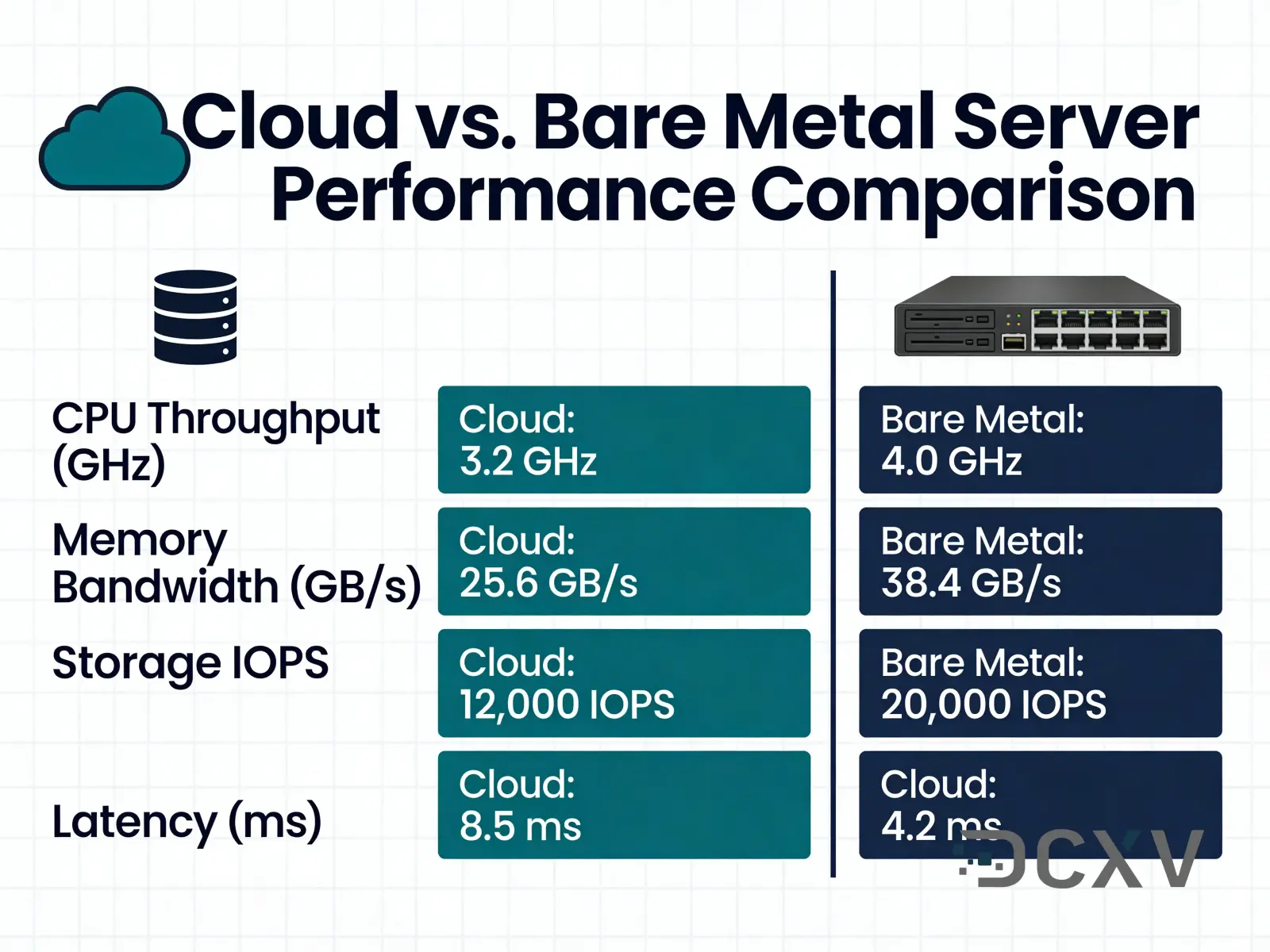
The core difference between Hetzner Cloud and a dedicated server is resource ownership. On Hetzner Cloud, your virtual machine shares physical hardware with other tenants. Your CPU cycles, memory bandwidth, and network I/O compete with neighbors on the same host. On a dedicated server, you own the physical hardware exclusively.
| Dimension | Hetzner Cloud | Dedicated Server |
|---|---|---|
| Resource isolation | Shared, noisy-neighbor possible | Full isolation, no sharing |
| Provisioning speed | Minutes | Hours to 24 hours |
| Scalability | Easy vertical and horizontal scale | Fixed spec, manual upgrade |
| Cost model | Per-hour, scales down easily | Monthly fixed, better per-core economics |
| Disk I/O | Shared NVMe pools, variable latency | Local NVMe or SATA, consistent performance |
Hetzner Cloud strengths include rapid provisioning, simple API-driven scaling, and cost efficiency for variable workloads. Dedicated server strengths include raw performance, full hardware control, and lower per-unit cost at consistent utilization.
When to choose Hetzner Cloud
Hetzner Cloud is the right choice for workloads that benefit from elastic scaling and where single-server performance is not the bottleneck. Practical use cases include:
Development and staging environments that need to be spun up and torn down frequently. Paying for a dedicated server to run a staging environment 20 hours a month makes little sense; a cloud VM that runs only when needed is more economical.
Web applications with variable traffic that need to scale out horizontally during peaks. Hetzner Cloud's API allows automated instance creation and deletion based on load metrics.
Containerized microservices architectures where workloads are distributed across many small instances rather than concentrated on powerful hardware.
Projects with uncertain resource requirements. Starting on cloud VMs lets you observe actual usage patterns before committing to dedicated hardware specifications.
Hetzner Cloud is also suitable for small businesses and solo operators who need a reliable server but do not require the raw performance of dedicated hardware and prefer the simplicity of managed infrastructure.
When to choose a dedicated server
Dedicated servers are the right choice when performance consistency, resource intensity, or cost efficiency at scale is the primary concern.
Database servers benefit enormously from dedicated hardware. Database workloads are sensitive to memory bandwidth, storage I/O latency, and CPU consistency - all of which are subject to variability on shared cloud infrastructure. A dedicated server running PostgreSQL, MySQL, or Redis will consistently outperform a cloud VM with similar spec sheets.
High-traffic applications with sustained load are better served by dedicated hardware. Once a cloud VM is running at 80%+ utilization consistently, you are paying the cloud premium for resources you would own more cheaply on dedicated hardware.
Machine learning inference and batch workloads that require GPU access or sustained high CPU utilization belong on dedicated hardware. Shared CPU credits and noisy-neighbor effects directly degrade inference throughput.
Security-sensitive workloads where you need to be certain no other tenant shares your hardware fall into dedicated territory. Hardware-level isolation eliminates side-channel attack vectors that are theoretically possible in shared environments.
Total cost of ownership comparison
For workloads running at high utilization around the clock, dedicated servers typically become more economical than cloud at a certain scale point. A rough comparison for a workload requiring 8 CPU cores, 32 GB RAM, and 500 GB fast storage:
On Hetzner Cloud, you would be looking at their CPX51 or similar tier - which is cost-effective by cloud standards but still carries the cloud price premium for flexible infrastructure. Costs include the instance, snapshot storage, and network egress for high-bandwidth applications.
On a dedicated server, the same resource footprint at a provider like DCXV (starting from EUR 15/month for VPS, with dedicated hardware available for comparable workloads) runs at a significantly lower monthly cost. The trade-off is that you pay for the server whether you use it or not - so this model favors workloads with stable, predictable demand.
For workloads that run 24/7 at consistent utilization, the break-even point between cloud and dedicated typically occurs somewhere around 40-60% of full hardware utilization, beyond which dedicated is cheaper.
Migration path from Hetzner Cloud to dedicated
Migrating from Hetzner Cloud to a dedicated server is technically straightforward for most workloads. The main steps are:
Provision the dedicated server and configure base OS, networking, and any required services (firewalls, VPN, monitoring agents).
Mirror your data from the Hetzner Cloud instance to the dedicated server using rsync, database replication, or block-level tools depending on your stack.
Validate application behavior on the dedicated server in parallel with your Hetzner Cloud instance.
Update DNS or load balancer configuration to point traffic at the dedicated server. Keep the Hetzner Cloud instance running as a fallback for 24-48 hours post-cutover.
The most common complication is workloads that rely on Hetzner-specific cloud features like their private networking, Floating IPs, or object storage. These require equivalent alternatives to be configured before migration: private networking can be replaced with WireGuard or similar, Floating IPs with IP failover configurations available from dedicated server providers.
DCXV dedicated servers provision within 24 hours and our engineers are available to assist with migration planning and network configuration. Provisioning in under 10 minutes for cloud instances, 24h for dedicated. Start at https://dcxv.com/data-center#dedi or contact sales@dcxv.com.
Comparing Hetzner Cloud to DCXV directly, rather than cloud versus your own dedicated hardware? See /alternatives/hetzner.